
Last Updated: July, 2026 | 14 minute read

Finding the right content marketing agency can feel like navigating a crowded marketplace with too many options and not enough clarity. This guide breaks down exactly what these agencies do, how much they cost, and how to select one that actually drives revenue for your business in 2026.
Quick Snapshot: What a Content Marketing Agency Actually Does (and Why It Matters in 2026)
Content marketing agencies plan, create, and distribute content, blogs, videos, email campaigns, and social media posts, designed to drive traffic, generate qualified leads, and ultimately increase revenue for specific industries. Understanding which content marketing strategies drive the highest ROI helps you evaluate whether their approach matches your goals. Unlike general marketing agencies that spread resources thin across channels, these firms specialize in building content engines that compound over time.
2026 market context at a glance:
- CMI 2025 data shows 87% of marketers credit content with boosting brand awareness, 74% for demand generation, and 49% for direct sales impact
- Rising customer acquisition costs on paid channels have pushed B2B and ecommerce brands to treat content as a growth engine rather than a side project
- HubSpot 2026 findings confirm organic search (SEO + blog content) remains the #1 ROI channel for B2B companies. B2B brands looking to build this engine with expert support can explore content marketing agency services as a starting point.
- Global content marketing spend passed $400 billion in 2022 and is projected to approach $2 trillion by 2032
This trajectory explains why specialized content marketing companies have become increasingly common, and why choosing the right one matters more than ever.
What most agencies offer:
- Strategy and roadmapping: Audience research, competitive analysis, editorial calendars, and topic cluster planning
- SEO techniques for organic growth: Technical optimization, on-page SEO, and link building to improve search visibility.
- Content creation: Written content (blogs, whitepapers, case studies), video production, and visual assets
- Distribution: Social media management, email marketing, and digital PR to amplify reach across multiple channels
- Analytics and optimization: Performance tracking, revenue attribution, and continuous improvement based on data
At-a-glance benefits for B2B and eCommerce brands:
- Predictable pipeline growth from organic traffic that compounds monthly
- Lower customer acquisition costs compared to paid advertising campaigns
- Stronger brand authority that influences buying decisions
- Scalable content creation process without expanding internal headcount
Why High-Performing Content Marketing Agencies Matter for B2B and Ecommerce Brands
The difference between an average content marketing agency and a top performer comes down to one thing: revenue accountability. Strong agencies link strategy, production, and distribution directly to pipeline and closed-won deals, not vanity metrics like page views or social media mentions.
Consider the data: HubSpot’s 2026 research confirms that organic channels remain the highest-ROI channel for B2B companies. CMI’s 2025 statistics reinforce this with concrete numbers, 87% of marketers credit content with boosting brand awareness, 74% for demand generation, and 49% attribute direct sales impact to their content efforts.
Average content marketing agencies produce content. Top performers build content systems, track attribution through the entire funnel, and iterate based on actual revenue data.
Examples of compounding value from strategic content:
- A pillar page published in 2024 continues generating qualified leads in 2026, reducing reliance on paid media
- A comparison article ranking for high-intent competitive keywords cuts paid search spend by capturing organic search traffic
- A well-structured resource hub becomes the go-to reference in an industry, driving inbound inquiries without ongoing ad spend
- Technical content written once serves as sales enablement collateral for years, shortening deal cycles
Why industry experience matters:
- Agencies with in-house B2B SaaS experience already understand product-led growth dynamics, longer sales cycles, and account-based marketing strategies
- Ecommerce-focused agencies know how to map content to purchase intent and integrate with conversion rate optimization efforts
- Generalist providers typically require longer ramp-up time and may miss nuances that affect content performance
How to Choose the Right Content Marketing Agency in 2026
A wrong-fit agency can waste 6–12 months of budget and damage brand credibility through off-target messaging or poor-quality content. Selection should be structured, not based on who has the flashiest website or the most aggressive sales pitch.
A 5-step selection process:
- Define measurable goals and key performance indicators before any agency conversations
- Clarify your ideal customer profile (ICP) and map the buying journey
- Set budget ranges and realistic time horizons
- Shortlist agencies by niche expertise and relevant case studies
- Run structured interviews with specific evaluation criteria
Budget context for 2026:
|
Company Size |
Typical Monthly Retainer |
Marketing Budget Allocation |
|
Small business |
$2,500–$10,000 |
6–12% of revenue to marketing |
|
Mid-market |
$10,000–$30,000 |
25–40% of marketing budget to content |
|
Enterprise |
$30,000–$100,000+ |
Dedicated content teams + agency partners |
Many B2B SaaS companies now invest in the $5,000–$50,000/month range, indicating more serious commitment to content as a growth lever.
Critical guidance:
- Avoid agencies that cannot show at least 2–3 case studies with pipeline or revenue impact
- Insist on clear reporting cadence and metrics alignment before signing any contract
- Expect realistic timelines: organic traffic growth becomes visible in 3–4 months, meaningful lead generation in 6–9 months, and fully compounding effects in 12+ months
- Agencies promising overnight results are red flags, measurable results from content take time to materialize
1. Define Measurable Goals and Non-Negotiable KPIs
The first step in hiring any content marketing agency is defining 3–5 clear KPIs before talking to anyone. Without these, you cannot evaluate proposals or measure success.
Concrete goal examples:
- Increase qualified demo requests from organic by 40% in 12 months
- Generate $500,000 in pipeline from content by Q4 2026
- Reduce cost per qualified lead from paid channels by 25% through organic traffic growth
- Achieve page-one rankings for 15 high-intent keywords in your target market
How to structure your KPIs:
- Separate leading metrics (website traffic, rankings, impressions) from lagging metrics (pipeline value, revenue, customer acquisition cost)
- Require agencies to report on both types with clear attribution methodology
- Include a budget range upfront (e.g., “we can invest $5,000–$20,000 per month for at least 9 months”) to filter misaligned proposals early
- Define what “success” looks like at 90 days, 6 months, and 12 months
2. Evaluate Industry and Channel Expertise
Industry expertise means the agency already understands your jargon, buyer objections, compliance constraints, and competitive landscape. This dramatically shortens ramp-up time.
Niche specialization examples:
- B2B SaaS: Understanding product-led growth, freemium conversion, and enterprise sales cycles
- Industrial manufacturing: Technical accuracy requirements, long buying committees, regulatory compliance
- Legal services: Bar advertising rules, jurisdiction-specific constraints, professional standards
- Healthcare and medical practices: HIPAA compliance, medical credibility standards, procedure-specific content
- Financial services and fintech: FINRA regulations, trust signals, data security messaging
Evaluation framework:
- Ask for 2–3 case studies from the last 24 months in your vertical with metrics like traffic growth, ranking improvements, and pipeline value created
- Look for demonstrated understanding of your target audience and buying process
- Avoid if they cannot name specific challenges or opportunities in your industry
- Match channel strengths to your growth levers, an agency excelling at long form content for SEO may not be the right fit for TikTok or Instagram-first strategies
3. Review Portfolios, Case Studies, and Process Transparency
Due diligence separates good agency relationships from expensive mistakes.
What to verify:
- Review actual URLs of client work, not just screenshots or testimonials
- Validate results with tools like Semrush or Ahrefs where possible, check if rankings and traffic claims hold up
- Look for case studies with clear structure: problem statement, strategy description, execution details, and quantified outcomes
Strong case study indicators:
- “38% organic traffic increase in 9 months”
- “11,000 monthly Pinterest views driving ecommerce conversions”
- “Page 2 → position #1 for high-intent keyword”
- Revenue or pipeline numbers, not just traffic metrics
Process questions to ask:
- Walk me through your research and briefing process
- How do you conduct SME interviews for technical content?
- What does your editing workflow look like (subject-matter review, copy editing, SEO optimization)?
- How do you handle distribution and promotion after publication?
Red flag: Agencies unable to articulate a clear, repeatable process represent significant risk to your investment.
Additional signals:
- Multi-year client relationships indicate consistent performance and strong satisfaction
- Ask for references and actually call them
- Request sample reports to understand what monthly communication looks like

Top 10 U.S. Content Marketing Agencies
Armed with the knowledge of what to look for in a great content and digital marketing agency now, let's dive into the top 10 very best content and digital marketing agency based on keyword research on companies and agencies that have made their mark in the industry.
These agencies not only tick all the boxes of our criteria, but also go above and beyond to deliver results that exceed their prospective client expectations. They have a proven track record of success in digital channel, with a portfolio of clients that range from small to large.
1. 310 Creative
Company Overview:
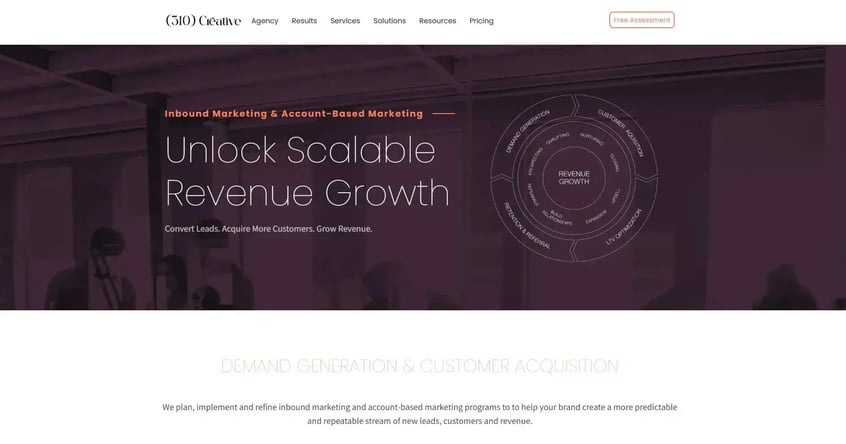
310 Creative is a B2B content marketing agency founded in 2003 and headquartered in Santa Monica, California. The agency helps companies generate pipeline and revenue through strategic content marketing programs designed to attract, educate, and convert target audiences. Working with SaaS, professional services, manufacturing, and technology companies, 310 Creative positions itself as a leading content marketing agency that builds scalable content engines aligned to business growth and customer acquisition.
Methodology & Services:
310 Creative’s methodology centers on content driven demand generation that supports the full buyer journey from awareness to conversion. The agency develops content strategies based on ideal customer profiles, buyer personas, and search intent to ensure alignment with revenue goals. Core services include content strategy development, blog and article creation, long form content such as ebooks and guides, SEO content optimization, landing page content, email marketing, and content for account based marketing campaigns. These initiatives are designed to increase organic visibility, engage target audiences, nurture leads, and support sales enablement through relevant and high value content assets.
Market Position & Brand Perception:
310 Creative positions itself as a leading content marketing partner for B2B organizations that want to build long term authority and consistent lead generation through content. Its integration of content marketing with inbound strategy, SEO, and marketing automation enables companies to create cohesive growth systems rather than isolated content efforts. The agency emphasizes measurable performance, aligning content initiatives with pipeline contribution and revenue outcomes. Engagements are typically structured as ongoing partnerships focused on continuous content production, optimization, and performance improvement.
Pros & Cons
Pros:
-
Strong specialization in content marketing strategy and execution for B2B growth
-
Integrated approach combining content with SEO, inbound marketing, and automation
-
Experience creating long form and conversion focused content across the buyer journey
-
Emphasis on measurable pipeline impact and revenue driven content performance
Cons:
-
Content marketing strategies typically require time to generate compounding results
-
Retainer based engagement model may require sustained investment in content production
-
Best suited for companies committed to long term content driven growth rather than short term campaign needs
2. Brafton
Company Overview:
Brafton is a full service content marketing agency founded in 2008 with headquarters in Boston, Massachusetts and offices in Chicago, San Francisco, and Sydney. The agency helps B2B and B2C companies generate leads, increase brand visibility, and drive revenue through strategic content marketing programs. Brafton positions itself as a leading content marketing agency, offering scalable content production and distribution capabilities for organizations seeking consistent, high quality content aligned to business objectives.
Methodology & Services:
Brafton’s methodology centers on content driven marketing strategies that align storytelling, search visibility, and audience engagement with measurable business outcomes. The agency develops content programs based on audience research, keyword strategy, and editorial planning to support the full marketing funnel. Core services include content strategy, blog and article writing, white papers, ebooks, video production, graphic design, SEO content optimization, email marketing, social media content, and content distribution. These initiatives are designed to attract qualified audiences, build brand authority, nurture leads, and support sales efforts through consistent and targeted content experiences.
Market Position & Brand Perception:
Brafton positions itself as a leading global content marketing partner capable of delivering both strategy and large scale content execution. Its ability to produce high volumes of content across multiple formats differentiates it from smaller boutique agencies. The agency is particularly well suited for organizations that need consistent content production combined with strategic oversight and performance tracking. Engagements are typically structured as ongoing programs focused on continuous content creation, optimization, and measurable impact on traffic, engagement, and lead generation.
Pros & Cons
Pros:
-
Strong specialization in content marketing strategy and large scale content production
-
Comprehensive services including writing, video, design, SEO, and content distribution
-
Ability to support both B2B and B2C organizations across multiple industries
-
Positioned as a leading content marketing agency with global delivery capabilities
Cons:
-
High volume content production model may be less tailored than boutique agencies for highly specialized needs
-
Ongoing content programs typically require sustained investment
-
May require internal alignment to ensure content strategy is fully integrated with broader marketing and sales efforts
3. WebFX
Company Overview:
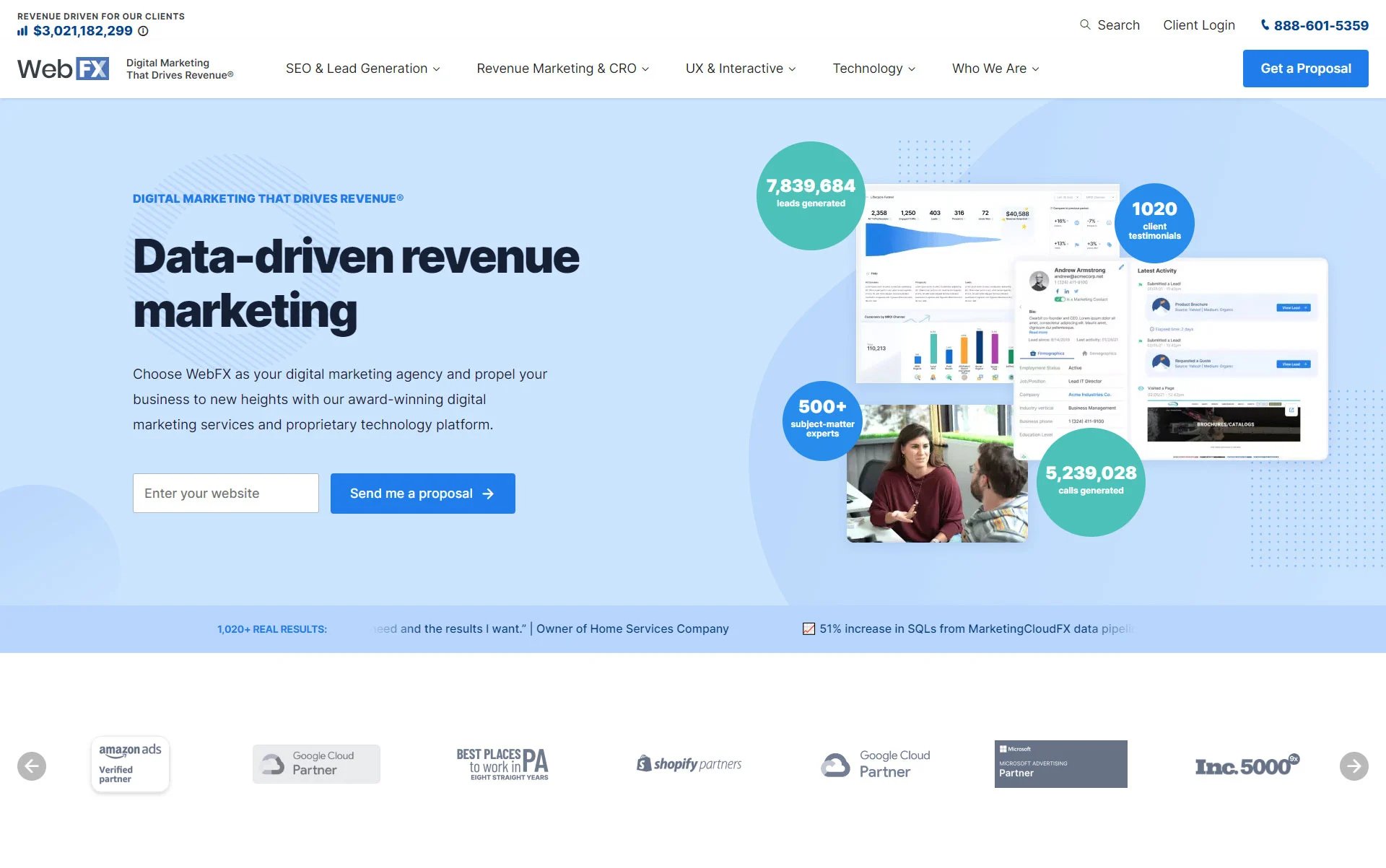
WebFX is a full service digital marketing agency founded in 1996 and headquartered in Harrisburg, Pennsylvania. The agency works with B2B and B2C companies across a wide range of industries, helping them generate leads, increase online visibility, and drive revenue through integrated digital marketing strategies. WebFX positions itself as a leading content marketing agency within a broader performance marketing offering, leveraging its proprietary technology and large in house team to deliver scalable marketing solutions.
Methodology & Services:
WebFX’s methodology centers on data driven content marketing strategies that align content creation with search visibility, user intent, and conversion performance. The agency develops content programs based on keyword research, audience analysis, and competitive insights to support the full marketing funnel. Core services include content strategy, blog writing, long form content such as guides and ebooks, SEO content optimization, video content, infographics, email marketing, and content distribution. These initiatives are supported by WebFX’s proprietary platform, MarketingCloudFX, which provides performance tracking and insights to optimize content effectiveness and measure ROI.
Market Position & Brand Perception:
WebFX positions itself as a leading content marketing and digital growth partner with the scale, technology, and expertise to support organizations of all sizes. Its ability to combine content marketing with SEO, paid media, and analytics differentiates it from agencies that focus solely on content. The agency is widely recognized in industry rankings and reviews for its performance driven approach and measurable results. Engagements are typically structured as ongoing programs designed to continuously produce, optimize, and scale content that drives traffic, engagement, and lead generation.
Pros & Cons
Pros:
-
Strong specialization in content marketing integrated with SEO and performance marketing
-
Large in house team capable of producing content at scale across formats
-
Proprietary analytics platform for tracking content performance and ROI
-
Recognized as a leading content marketing agency with a long operational history
Cons:
-
Broad service offering may be more comprehensive than needed for companies seeking only content marketing
-
Large scale delivery model may feel less customized for highly niche industries
-
Ongoing content marketing programs typically require sustained investment
4. Animalz
Company Overview:
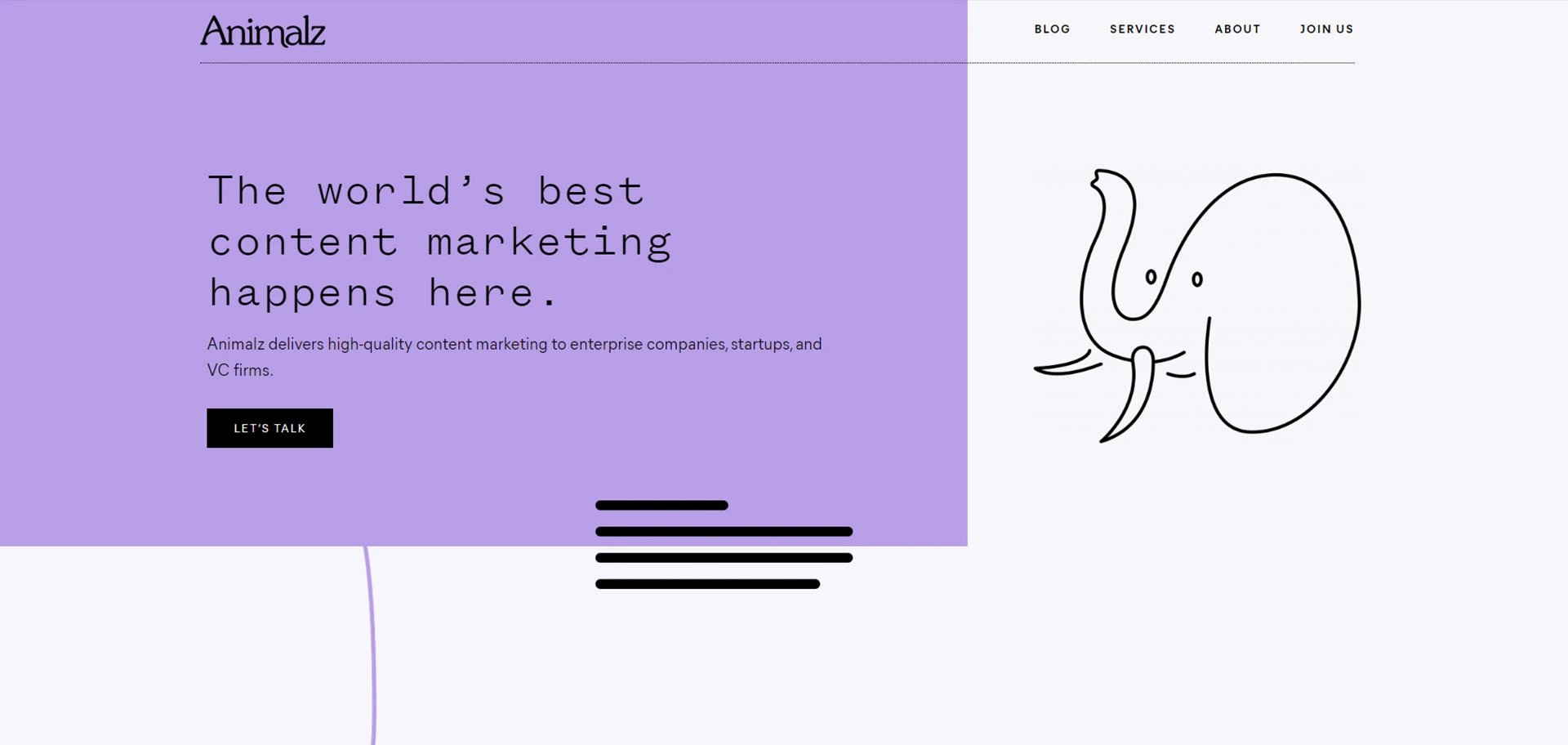
Animalz is a B2B content marketing agency founded in 2015 that helps SaaS and technology companies grow through high quality, strategic content programs. The agency works with venture backed startups and enterprise technology brands to build authority, educate buyers, and drive sustainable pipeline growth. Animalz positions itself as a leading content marketing agency that prioritizes depth, expertise, and business impact over high volume content production.
Methodology & Services:
Animalz’s methodology centers on research driven content marketing that aligns with product positioning, audience intent, and revenue goals. The agency begins with in depth analysis of the client’s industry, competitors, and target audience to develop a strategic editorial roadmap. Core services include long form blog content, thought leadership articles, white papers, customer stories, product marketing content, SEO informed content strategy, and content optimization. These initiatives are designed to attract high intent audiences, support sales conversations, and build category authority rather than simply increase traffic.
Market Position & Brand Perception:
Animalz positions itself as a leading content marketing partner for B2B SaaS and technology companies that require high impact, strategic content to support complex buying decisions. Its reputation is built on producing premium content that drives meaningful engagement and contributes to pipeline growth. The agency is particularly well suited for organizations that value quality, insight driven content and long term authority building over short term content output. Engagements are typically structured as ongoing partnerships focused on sustained content investment and performance improvement.
Pros & Cons
Pros:
Strong specialization in B2B SaaS content marketing and thought leadership development
Emphasis on high quality, research driven content aligned to business outcomes
Focus on building authority and supporting complex buyer journeys
Recognized as a leading content marketing agency for technology companies
Cons:
-
Premium content approach may require higher investment compared to volume based content providers.
-
Primarily focused on content rather than full service digital marketing
-
Results from content marketing typically require time to compound and deliver measurable impact
5. Column Five
Company Overview:
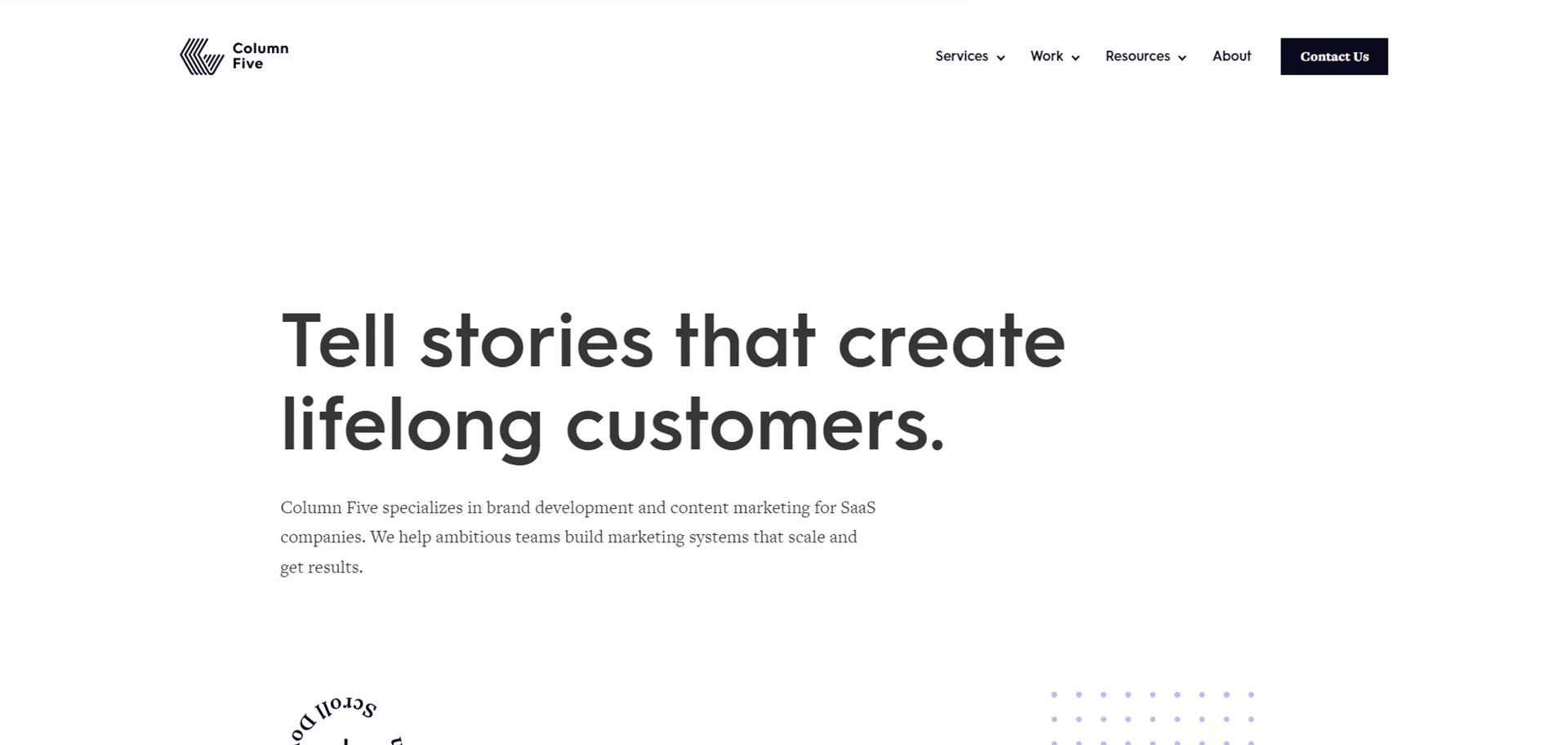
Column Five is a content marketing and brand storytelling agency founded in 2009 with offices in California and New York. The agency helps B2B and B2C organizations grow brand awareness, audience engagement, and demand generation through strategic content experiences. Column Five positions itself as a leading content marketing agency known for combining creative storytelling, design, and data driven strategy to help brands communicate complex ideas and build long term audience relationships.
Methodology & Services:
Column Five’s methodology centers on content driven storytelling that combines strategy, creativity, and audience insights to create engaging marketing experiences. The agency develops content programs based on audience research, brand positioning, and campaign objectives to support awareness, engagement, and lead generation. Core services include content strategy, brand storytelling, blog and article creation, infographics, research reports, interactive content, video production, social media content, and visual design. These initiatives are designed to help brands increase visibility, strengthen authority, and create memorable content experiences that support marketing and sales objectives.
Market Position & Brand Perception:
Column Five positions itself as a leading content marketing and creative storytelling agency that helps organizations differentiate themselves through high quality visual and narrative content. The agency is particularly recognized for its expertise in data visualization, branded storytelling, and integrated content campaigns that combine creative design with strategic messaging. Engagements are typically structured around ongoing content and campaign initiatives designed to build audience engagement, brand authority, and measurable marketing impact over time.
Pros & Cons
Pros:
-
Strong specialization in content marketing, storytelling, and visual content creation
-
Expertise in infographics, research driven content, and multimedia campaigns
-
Emphasis on combining creative design with strategic marketing objectives
-
Recognized as a leading content marketing agency for branded storytelling
Cons:
-
Premium creative and strategic services may require higher investment levels
-
Strong focus on brand storytelling may be less performance driven than purely SEO focused content agencies
-
Engagements often require ongoing collaboration and sustained content investment for long term impact
6. Propllr
Company Overview:
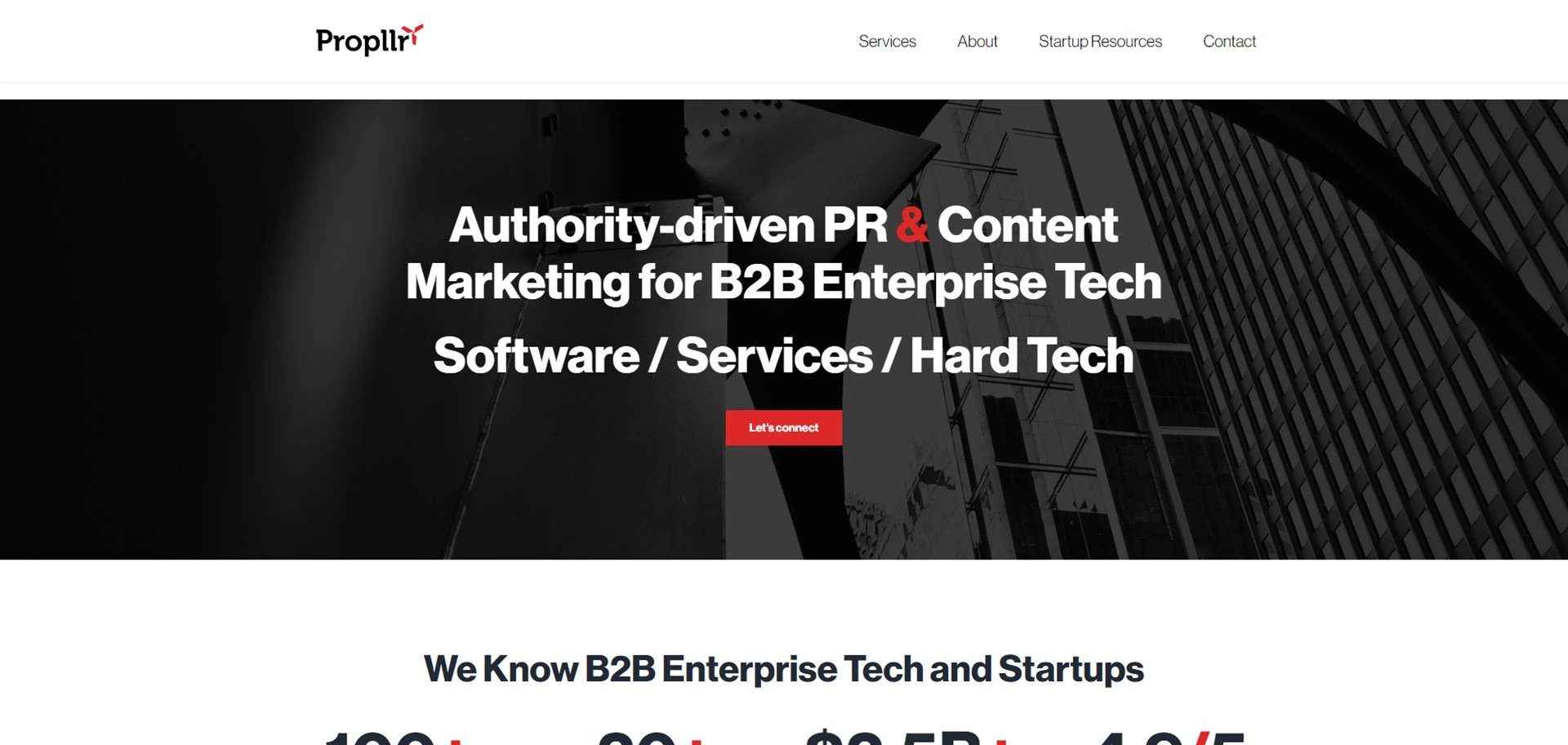
Propllr is a B2B content marketing and public relations agency founded in 2011 and headquartered in Chicago, Illinois. The agency specializes in helping startups, technology companies, and growth focused brands increase visibility, build authority, and generate demand through strategic content marketing and communications programs. Propllr positions itself as a leading content marketing agency for emerging and high growth companies that need to strengthen brand awareness and engage targeted audiences through compelling storytelling and thought leadership.
Methodology & Services:
Propllr’s methodology centers on content driven brand storytelling that combines strategic messaging, audience engagement, and media visibility to support business growth. The agency develops content strategies based on market positioning, buyer interests, and industry trends to create relevant and engaging content experiences. Core services include content strategy, blog and article writing, thought leadership development, public relations, media outreach, social media content, video production, podcast development, and SEO informed content creation. These initiatives are designed to increase brand credibility, attract targeted audiences, and support lead generation and sales enablement through high value content assets.
Market Position & Brand Perception:
Propllr positions itself as a leading content marketing and communications partner for startups and innovation driven companies seeking to build market awareness and long term audience engagement. The agency is particularly recognized for integrating content marketing with PR and earned media strategies to amplify reach and strengthen brand positioning. Engagements are typically structured around ongoing content and communications programs designed to support sustainable visibility, authority building, and measurable marketing impact.
Pros & Cons
Pros:
-
Strong specialization in content marketing, thought leadership, and brand storytelling
-
Integrated approach combining content marketing with public relations and media outreach
-
Well suited for startups and growth focused technology companies
-
Emphasis on building brand authority and audience engagement through strategic content
Cons:
-
Strong communications and branding focus may be less performance driven than SEO centric content agencies
-
Ongoing content and PR initiatives typically require sustained investment for measurable impact
-
Best suited for companies prioritizing awareness and authority building alongside lead generation
7. 97th Floor
Company Overview:
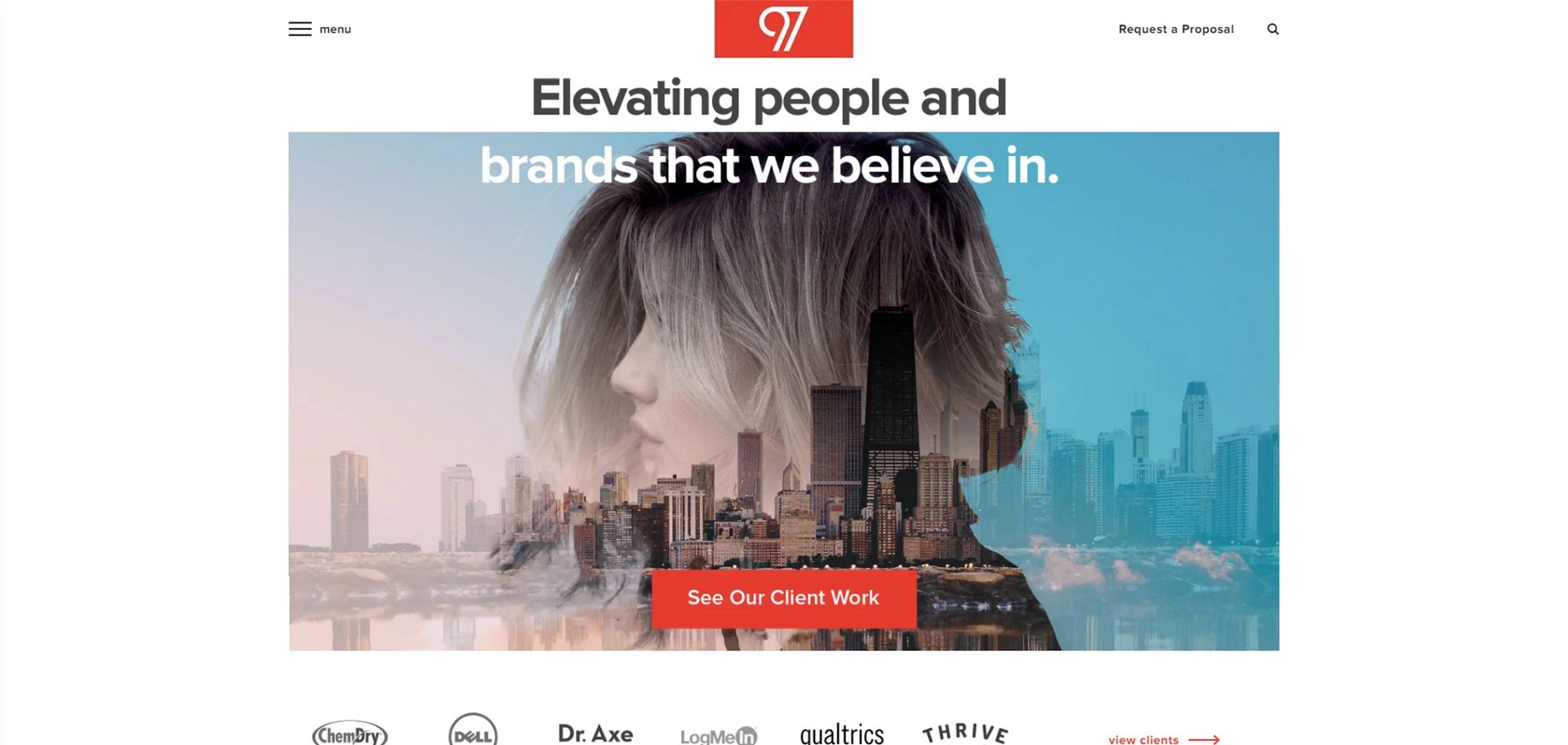
97th Floor is a digital marketing and content marketing agency founded in 2005 and headquartered in Lehi, Utah. The agency works with B2B and B2C organizations across industries such as SaaS, technology, finance, healthcare, and eCommerce to increase visibility, generate leads, and drive revenue growth. 97th Floor positions itself as a leading content marketing agency that combines strategic storytelling, SEO, and digital performance marketing to help brands build authority and sustainable audience engagement.
Methodology & Services:
97th Floor’s methodology centers on content driven growth strategies that integrate storytelling, search visibility, and audience engagement across the marketing funnel. The agency develops content programs based on audience research, keyword strategy, competitive analysis, and conversion objectives to create targeted content experiences. Core services include content strategy, blog and article creation, long form content, video production, SEO content optimization, creative campaigns, social media content, email marketing, and digital PR. These initiatives are designed to attract qualified audiences, improve organic visibility, nurture leads, and support revenue growth through consistent and strategically aligned content.
Market Position & Brand Perception:
97th Floor positions itself as a leading content marketing and digital growth partner known for combining creative storytelling with measurable marketing performance. The agency is recognized for its integrated approach that connects content marketing with SEO, paid media, and analytics to maximize audience reach and business impact. Engagements are typically structured around ongoing content and digital marketing programs designed to build long term authority, increase engagement, and generate measurable pipeline growth.
Pros & Cons
Pros:
-
Strong specialization in content marketing integrated with SEO and digital strategy
-
Expertise in creating multi format content including blogs, video, and creative campaigns
-
Emphasis on measurable marketing performance and audience engagement
-
Recognized as a leading content marketing agency with experience across multiple industries
Cons:
-
Broad digital marketing offering may be more comprehensive than needed for companies seeking only content services
-
Premium strategic and creative services may require higher ongoing investment
-
Long term content marketing programs typically require time to generate compounding results
8. Ten Speed
Company Overview:
Ten Speed is a B2B SaaS content marketing agency that helps software and technology companies grow pipeline and revenue through strategic content and SEO programs. Founded in 2017 and headquartered in Chicago, Illinois, the agency focuses primarily on SaaS and technology organizations that need scalable inbound growth driven by high quality content. Ten Speed positions itself as a leading content marketing agency for SaaS brands seeking to build authority, improve organic visibility, and generate qualified demand through educational and search driven content.
Methodology & Services:
Ten Speed’s methodology centers on content marketing strategies that combine SEO, subject matter expertise, and audience intent to create long term organic growth. The B2B agency develops editorial strategies informed by keyword research, customer journey analysis, competitive positioning, and conversion goals. Core services include content strategy, SEO content creation, long form blog articles, technical and product focused content, thought leadership development, content optimization, and organic growth consulting. These initiatives are designed to attract high intent buyers, educate target audiences, support product adoption, and contribute directly to pipeline generation and revenue growth.
Market Position & Brand Perception:
Ten Speed positions itself as a leading content marketing and SEO partner for SaaS and technology companies that prioritize sustainable inbound growth and authoritative brand positioning. The agency is recognized for producing technically accurate, research driven content tailored to sophisticated B2B buyers. Its specialized focus on SaaS differentiates it from broader digital marketing agencies, making it particularly well suited for organizations with complex products and long buying cycles. Engagements are typically structured as ongoing partnerships designed to create scalable content engines and measurable organic growth over time.
Pros & Cons
Pros:
-
Strong specialization in content marketing and SEO for SaaS and technology companies
-
Emphasis on technically accurate, research driven content for sophisticated B2B audiences
-
Focus on long term organic growth and pipeline contribution rather than vanity metrics
-
Recognized as a leading content marketing agency for SaaS inbound growth
Cons:
-
Primary focus on organic content growth may be less suitable for companies seeking rapid paid acquisition results
-
Specialized SaaS focus may limit relevance for non technology industries
-
Content marketing strategies typically require sustained investment and time to generate compounding results
9. Builtvisible
Company Overview:
Builtvisible is a digital marketing and content strategy agency founded in 2009 and headquartered in London, United Kingdom. The agency helps brands improve organic visibility, audience engagement, and revenue growth through integrated content marketing and SEO strategies. Builtvisible works with companies across sectors such as technology, ecommerce, finance, travel, and media, positioning itself as a leading content marketing agency known for combining technical expertise, strategic storytelling, and search driven performance.
Methodology & Services:
Builtvisible’s methodology centers on content marketing strategies that integrate audience research, SEO, digital PR, and creative storytelling to build authority and drive measurable engagement. The agency develops content programs informed by keyword research, search intent analysis, competitor benchmarking, and customer journey mapping. Core services include content strategy, editorial planning, long form content creation, SEO content optimization, digital PR, outreach campaigns, video and visual content, and technical SEO support. These initiatives are designed to increase organic visibility, attract targeted audiences, strengthen brand authority, and support long term demand generation.
Market Position & Brand Perception:
Builtvisible positions itself as a leading content marketing and organic growth agency that blends strategic content development with advanced SEO and digital PR capabilities. The agency is recognized for its expertise in creating content ecosystems that improve search performance while delivering high value experiences for users. Engagements are typically structured around ongoing content and optimization programs designed to produce sustainable visibility, audience growth, and measurable business impact over time.
Pros & Cons
Pros:
-
Strong specialization in content marketing integrated with SEO and digital PR
-
Emphasis on search intent, audience engagement, and long term authority building
-
Expertise in both creative storytelling and technical organic growth strategy
-
Recognized as a leading content marketing agency with international experience
Cons:
-
Premium strategic and technical services may require higher investment levels
-
Strong focus on organic growth means results may take time to compound
-
Best suited for companies committed to long term content and SEO strategies rather than short term campaign execution
10. Omniscient Digital
Company Overview:
Omniscient Digital is a B2B SaaS content marketing and SEO agency founded in 2019 and headquartered in Austin, Texas. The agency helps software and technology companies grow pipeline and recurring revenue through strategic content marketing programs designed to build authority and increase organic visibility. Omniscient positions itself as a leading content marketing agency for SaaS and technology brands that want to create sustainable inbound growth through high quality, search driven content.
Methodology & Services:
Omniscient Digital’s methodology centers on content marketing strategies that align SEO, audience intent, and business outcomes to drive long term organic growth. The agency begins with deep research into customer pain points, competitive positioning, keyword opportunities, and product messaging to create a strategic content roadmap. Core services include content strategy, SEO content creation, long form blog articles, thought leadership content, technical SEO, digital PR, link acquisition, and content optimization. These initiatives are designed to attract high intent audiences, support product education, nurture leads, and increase pipeline contribution through authoritative content experiences.
Market Position & Brand Perception:
Omniscient Digital positions itself as a leading content marketing and SEO partner for SaaS and technology companies that prioritize long term authority and sustainable demand generation. The agency is recognized for combining strategic content development with technical SEO expertise to create measurable business impact rather than vanity traffic metrics. Engagements are typically structured as ongoing partnerships focused on building scalable content engines that compound over time and contribute directly to qualified pipeline and revenue growth.
Pros & Cons
Pros:
• Strong specialization in content marketing and SEO for SaaS and technology companies
• Emphasis on high intent, search driven content tied to pipeline and revenue goals
• Integrated expertise across content strategy, technical SEO, and digital PR
• Recognized as a leading content marketing agency for sustainable organic growth
Cons:
• Primary focus on organic growth may be less suitable for companies seeking rapid paid acquisition results
• Premium strategic content programs may require sustained long term investment
• Best suited for organizations committed to content driven inbound growth rather than short term campaigns
What Services Do Content Marketing Agencies Provide in 2026?
Most content marketing agencies bundle strategy, creation, SEO, and promotion, but the mix and depth vary significantly by firm and industry focus. Understanding the full service offerings helps you evaluate what you actually need.
Core service categories:
|
Category |
Typical Deliverables |
|
Strategy and roadmapping |
Editorial calendars, topic clusters, buyer journey maps, competitive analysis |
|
SEO and keyword research |
Technical audits, on-page optimization, keyword strategies, internal linking |
|
Content creation |
Blog posts, whitepapers, case studies, videos, infographics, email sequences |
|
Distribution |
Social media posts, newsletter management, digital PR, repurposing |
|
Analytics and reporting |
Monthly reports, attribution modeling, performance dashboards |
Concrete deliverable examples:
- 4 SEO blog posts per month optimized for search engines
- 2 case studies per quarter featuring customer success stories
- 1 animated explainer video per product launch
- 1 monthly email newsletter with original content
- Quarterly content audits with refresh recommendations
Specific capabilities to look for:
- Optimization for AI Overviews and LLMs (Generative Engine Optimization or GEO)
- Repurposing workflows for short-form video across Instagram Reels, TikTok, and YouTube Shorts
- Integration with first-party data from CRMs and marketing automation platforms
- Some agencies also offer web development, marketing automation setup, and conversion rate optimization, blurring the line between content agency and full-service digital agency
Strategy and Content Roadmapping
Strong agencies invest 4–8 weeks in a discovery and strategy phase before producing any content. This foundation determines whether subsequent work drives business growth or simply fills a content calendar.
What strategy work includes:
- Audience research: ICP refinement, buyer persona development, pain point identification
- Competitive analysis: Content gap analysis, ranking opportunities, differentiation angles
- Keyword research: Topic clustering, intent mapping, prioritization by revenue potential
- Content audits: Existing asset inventory, performance scoring, refresh opportunities
Resulting deliverables:
- 3–6 month editorial calendar with specific topics, target keywords, and publication dates
- Topic cluster maps showing pillar pages and supporting content relationships
- Target URLs and internal linking strategy
- KPIs tied to each content initiative with clear measurement methodology
What to insist on:
- Buyer-journey mapping covering awareness, consideration, and decision stages
- Topic clusters built around pillar pages, not random blog posts
- Prioritization of high-intent keywords first (closest to revenue)
- Clear connection between content topics and your target market
SEO and Technical Optimization
Understanding the difference between content SEO and technical SEO helps you evaluate what an agency actually delivers.
Content SEO (on-page optimization):
- Keyword integration and density optimization
- Meta titles and descriptions
- Header structure and content organization
- Internal linking to related pages
- Content refresh recommendations for existing blog content
Technical SEO:
- Full site crawl audits using tools like Screaming Frog
- Fixing 404 errors and redirect chains
- Site speed optimization and Core Web Vitals improvements
- Schema markup implementation for rich snippets
- Site architecture recommendations
Link building approaches:
- Digital PR: Pitching original research or data to publications for backlinks
- Guest posting: Contributing articles to industry publications
- Resource link outreach: Getting included in relevant resource lists
- Some agencies handle link building in-house while others partner with specialists
Generative Engine Optimization (GEO):
This 2026 differentiator involves structuring content for AI-driven search experiences like Google AI Overviews and ChatGPT responses. Best practices include:
- Clear, descriptive subheadings
- Concise Q&A sections with explicit answers
- Authoritative citations and source links
- Structured data that helps AI systems understand content
Content Creation: Articles, Thought Leadership, Video, and Beyond
Content marketing agencies provide creation services across multiple formats, tailored to your industry and audience preferences.
Written content formats:
- Blog posts optimized for organic search
- Whitepapers and ebooks for lead generation
- Case studies showcasing customer results
- Landing pages designed for conversion
- Email sequences for nurturing and retention
- Sales enablement collateral (one-pagers, comparison guides, ROI calculators)
Industry-specific content examples:
- Legal blogs covering practice areas and local jurisdiction topics for attorneys
- Technical explainers breaking down complex B2B SaaS functionality
- Medical practice content for specific procedures and patient education
- Fintech content navigating regulatory requirements while building trust
Video formats agencies handle:
- Product demo videos and feature walkthroughs
- Customer testimonial videos
- Explainer and educational videos
- Webinar production and hosting
- Short-form social clips (15–60 seconds) for Instagram Reels, TikTok, and YouTube Shorts
Process best practices for high quality content:
- Structured SME interview processes, especially critical in complex fields like healthcare, cybersecurity, or enterprise software companies
- Layered editing: subject-matter review for accuracy, copy editing for clarity, SEO optimization for visibility
- Brand voice guidelines ensuring consistency across all content
- Quality assurance checks before publication
Distribution: SEO, Social Media, Email, and Digital PR
Top content marketing firms recognize that creating content is only half the equation. Distribution determines whether that content actually reaches your target audience.
Organic search distribution:
- Building topic clusters that reinforce authority on key subjects
- Strategic internal linking to distribute page authority
- Regular content refreshes to maintain and improve rankings
Social media strategy by platform:
- LinkedIn and X (Twitter) for B2B tech and professional audiences
- Pinterest and Instagram for design, lifestyle, and eCommerce brands
- YouTube for explainer content and customer testimonials
- TikTok for brand awareness with younger demographics
Repurposing tactics:
- Converting a research report into blog posts, LinkedIn threads, infographics, email series, and short-form videos
- Turning webinar content into 20+ social clips and written summaries
- Extracting key insights from long form content for social media posts
Email marketing integration:
- Newsletter content featuring original insights and curated industry news
- Nurture sequences for lead generation using educational content
- Behavior-based follow-ups triggered by content engagement
- Integration with marketing automation platforms like HubSpot or Marketo
Digital PR and outreach:
- Pitching flagship pieces (original research, industry surveys) to relevant publications
- Building relationships with journalists and industry influencers
- Securing backlinks that improve domain authority and search visibility
Analytics, Reporting, and Revenue Attribution
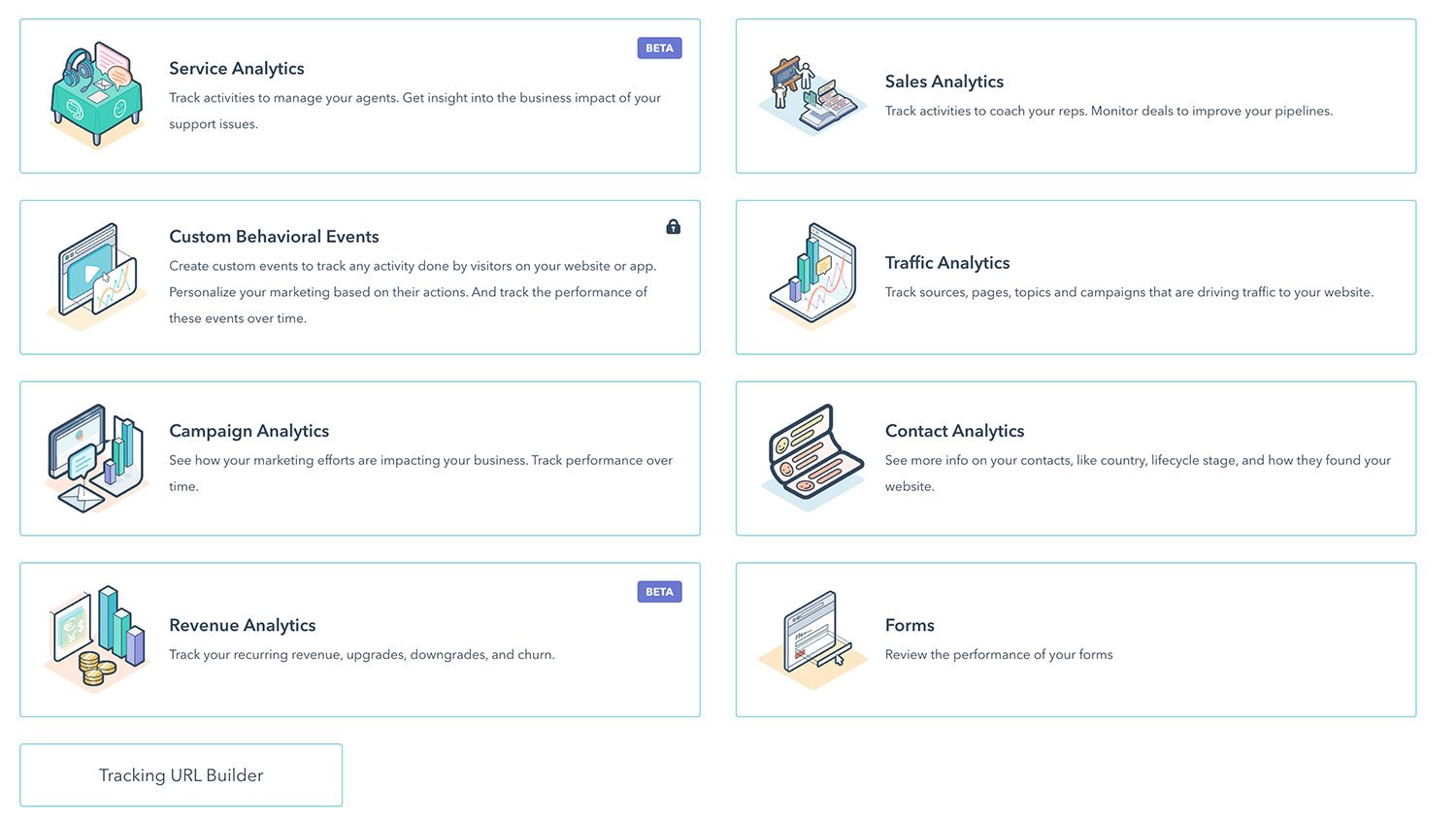
Serious agencies provide monthly or quarterly reports showing performance against agreed-upon metrics. This reporting should connect content activity to measurable outcomes.
Tools commonly used in 2026:
- GA4 for traffic, engagement, and conversion tracking
- Google Search Console for search visibility and ranking data
- Marketing automation platforms (HubSpot, Marketo) for lead tracking
- CRM integration (Salesforce) for pipeline attribution
- SEO platforms (Semrush, Ahrefs) for competitive analysis and ranking monitoring
Key metrics to expect:
|
Metric Category |
Specific Measurements |
|
Traffic |
Organic sessions, new users, engagement rate |
|
Rankings |
Keyword positions, visibility score, featured snippets |
|
Lead generation |
Form fills, demo requests, content downloads |
|
Pipeline |
Influenced pipeline value, first-touch vs. multi-touch attribution |
|
Revenue |
Content-attributed closed deals, CAC impact |
Attribution models explained:
- First-touch attribution: Credits the first piece of content a prospect encountered
- Multi-touch attribution: Distributes credit across all content interactions in the buying journey
- Last-touch attribution: Credits the final content before conversion
For B2B companies with longer sales cycles (often 3–9 months), multi-touch attribution provides more accurate insight into how content influences buying decisions.
Before signing, request:
- Sample monthly reports from current clients
- Explanation of how they track pipeline and revenue impact
- Clear definition of which metrics they will report and how often
- Access to live dashboards if available
Pricing Models: How Much Do Content Marketing Agencies Cost in 2026?
Pricing depends on scope, complexity, industry specialization, and the depth of strategy and SEO involved. However, common bands and models provide useful benchmarks.
Concrete pricing ranges:
|
Pricing Type |
Typical Range |
|
Monthly retainers (small business) |
$2,500–$10,000 |
|
Monthly retainers (mid-market/enterprise) |
$10,000–$50,000+ |
|
Hourly rates |
$75–$275 |
|
Project fees |
$3,000–$100,000+ |
Many B2B companies increased content budgets between 2025 and 2026, with a growing concentration in the $15,000–$45,000/month range. This indicates more serious investments in content as a measurable growth driver.
Four main pricing models:
- Monthly retainers: Fixed monthly fees for ongoing work
- Per-project pricing: Flat fees for specific deliverables
- Hourly rates: Time-based billing for consulting or overflow work
- Performance-based: Fees tied to outcomes like leads or revenue
Monthly Retainers
Monthly retainers are the industry standard for comprehensive content marketing services. They provide fixed monthly fees covering strategy, production, SEO, and reporting.
What retainer packages typically include:
|
Package Level |
Monthly Investment |
Typical Deliverables |
|
Starter |
$5,000/month |
4 SEO blog posts, basic on-page SEO, monthly reporting |
|
Growth |
$15,000/month |
8 blog posts, technical SEO audits, link building, video content |
|
Enterprise |
$30,000+/month |
Full content program, dedicated team, custom video, email sequences |
Benefits for clients:
- Predictable monthly spend for budgeting
- Consistent execution and momentum
- Stronger long-term strategy development
- Dedicated team that understands your business deeply
Before signing a retainer:
- Clarify exact scope: number of content pieces, revision rounds, included channels
- Confirm minimum contract length (typically 3–12 months)
- Align on KPIs and success criteria
- Understand what happens if deliverables are missed
Per-Project Pricing
Project-based pricing works well for specific initiatives or when testing agency fit before committing to longer relationships.
Common project types and pricing:
- Content bundle (5–10 blog posts): $3,000–$15,000
- Website content overhaul with SEO: $20,000–$80,000
- Brand messaging and positioning refresh: $10,000–$25,000
- Flagship video or whitepaper campaign: $5,000–$30,000
- Comprehensive content marketing strategy development: $15,000–$40,000
When project pricing makes sense:
- Testing agency fit before a longer engagement
- Accomplishing specific milestones with clear deliverables
- Limited budget without capacity for ongoing retainer
- One-time initiatives like website relaunches or rebrands
Recommendations for project engagements:
- Insist on detailed deliverable lists with acceptance criteria
- Define clear timelines with milestone checkpoints
- Structure payments appropriately (e.g., 50% upfront, 25% mid-project, 25% on delivery)
- Include revision rounds in the scope
Hourly Rates
Hourly billing is most appropriate for consulting, strategy sessions, audits, or overflow production rather than comprehensive content marketing programs.
Typical hourly ranges:
- Generalist content work: $75–$150/hour
- Senior strategists: $150–$200/hour
- Specialized technical writers (cybersecurity, enterprise AI, medical): $200–$275/hour
Pros of hourly pricing:
- Flexibility for short or variable engagements
- Easy to scale up or down based on needs
- Good for advisory relationships
Cons of hourly pricing:
- Harder to predict total costs
- Requires trust in time reporting accuracy
- Less incentive for efficiency
Best practices:
- Define a cap on hours per month
- Request detailed timesheets or summaries
- Tie hours to specific deliverables or outcomes where possible
Performance-Based and Hybrid Models
Performance-based pricing ties agency fees to outcomes like generating qualified leads, pipeline value, or actual sales. This model is less common but increasingly offered by confident agencies.
How hybrid models typically work:
- Lower base retainer ($5,000–$10,000/month) covering core execution
- Bonus payments if content-generated pipeline exceeds agreed thresholds
- Percentage of revenue for eCommerce content marketing campaigns
When this model works:
- Agency has proven track record in your specific industry
- Clear attribution tracking is already in place
- Both parties agree on how success will be measured
- Initial baseline period establishes realistic targets
Cautions:
- Attribution complexity makes pure performance models difficult in enterprise B2B
- Long sales cycles (6–12 months) delay measurement of true impact
- May create misaligned incentives if poorly structured
- Most agencies require an initial retainer period before introducing performance elements
Types of Content Marketing Agencies: Niche vs. Full-Service
Understanding the difference between specialized content agencies and full-service digital marketing agencies helps you choose the right partner for your situation.
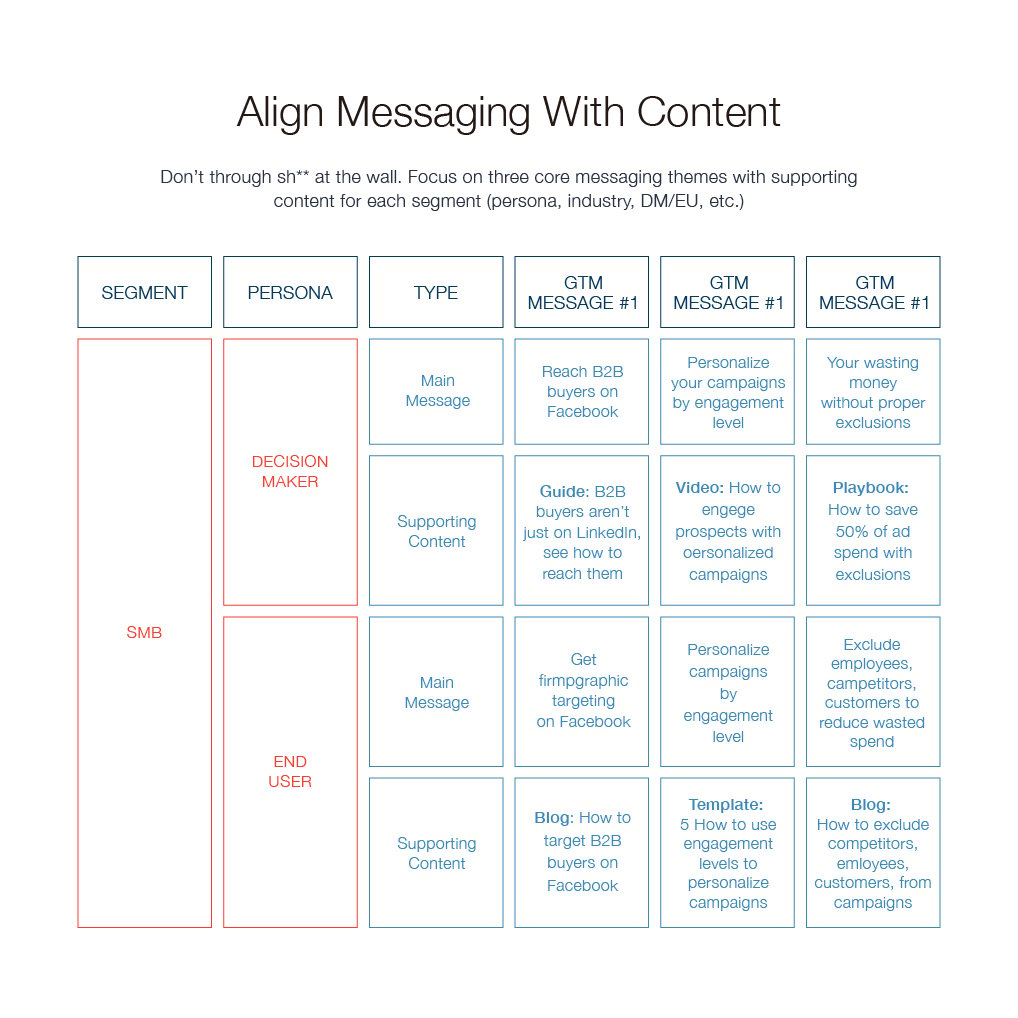
Niche content agencies focus on:
- Content strategy, creation, and SEO as core competencies
- Deep expertise in specific verticals (B2B SaaS, industrial, legal, healthcare, fintech, hospitality, tourism)
- Faster ramp-up due to existing industry knowledge
- Typically smaller teams with more specialized skills
Specialized content marketing agencies typically develop a more focused SEO strategy, which is essential for building organic authority, driving lead generation, and enabling precise performance measurement.
Full-service digital agency capabilities:
- Integrated campaigns across paid media, organic, and owned channels
- Single point of accountability for all marketing activities
- Coordination between content, paid advertising, web design, and conversion optimization
- Often larger teams with broader but potentially shallower expertise
Which type fits your needs:
|
Your Situation |
Better Fit |
|
Early-stage B2B SaaS prioritizing organic growth |
Niche SEO/content specialist |
|
Mid-market company with limited marketing staff |
Full-service partner as extended team |
|
Highly regulated industry (healthcare, finance, legal) |
Niche agency with compliance expertise |
|
DTC brand needing paid social + content integration |
Full-funnel digital agency |
|
Enterprise with existing paid team needing content expertise |
Specialized content agency |
Industry-Specific Content Marketing Agencies
Some agencies build entire practices around single verticals, developing deep expertise that generalists cannot match.
Examples of vertical specialization:
- B2B technology and software companies: Agencies like Animalz (clients include Airtable, Wistia, Clearbit) and Ten Speed specialize in SaaS-native content
- Manufacturing and industrial: Agencies understanding technical complexity, long buying cycles, and trade publication dynamics
- Legal services: Specialists familiar with bar advertising rules, jurisdiction-specific content, and attorney credentialing
- Medical practices: Agencies experienced with HIPAA compliance and medical accuracy requirements
- Financial services and fintech: Understanding FINRA regulations, trust signals, and data security messaging
- Hospitality and tourism: Content for hotels, restaurants, and travel experiences with seasonal considerations
- Home services (HVAC, pest control, plumbing): Local SEO expertise combined with service-specific content
Advantages of vertical specialists:
- Already know regulatory constraints and compliance requirements
- Understand industry jargon and buyer psychology
- Have existing relationships with SMEs and industry publications
- Produce accurate, compliant content faster with fewer revisions
- Case studies directly relevant to your competitive landscape
For organizations in regulated or highly technical industries, prioritizing specialization over generic providers significantly reduces risk and accelerates results.
Full-Service Digital and Content Marketing Agencies
Full-service shops combine content marketing with SEO, paid search, paid social, web development, CRO, and marketing automation under one roof.
When full-service makes sense:
- Consumer brands needing integrated campaigns across every channel
- Ecommerce stores requiring coordination between content, advertising campaigns, and conversion optimization
- Multi-location businesses managing local SEO, paid local, and brand content together
- Real estate companies integrating property content with lead generation
Typical full-service engagement structure:
- Content strategy tied directly to paid media campaigns
- Email flows triggered by content engagement
- Landing pages designed and optimized as part of content programs
- Unified analytics connecting performance marketing to content attribution
- Single monthly report covering all channels
Examples of full-service agencies from the research:
- Single Grain: Full-service growth marketing across SEO, content, paid media, and demand generation
- Power Digital: Performance marketing integrating content, SEO, and paid media with proprietary analytics
- New North: Branding, content, paid media, ABM, and sales enablement in one offering
Considerations:
- Full-service can mean “good at everything” or “mediocre at everything”, verify depth in content specifically
- Coordination benefits only matter if execution quality is high
- May be more expensive than specialized content partners
- Best for brands with limited internal marketing staff needing a complete team
How Top Content Marketing Agencies Deliver ROI: Process from Audit to Revenue
Strong content marketing agencies follow a repeatable process: audit → strategy → production → distribution → optimization → reporting. Each step ties back to business goals and trackable metrics.
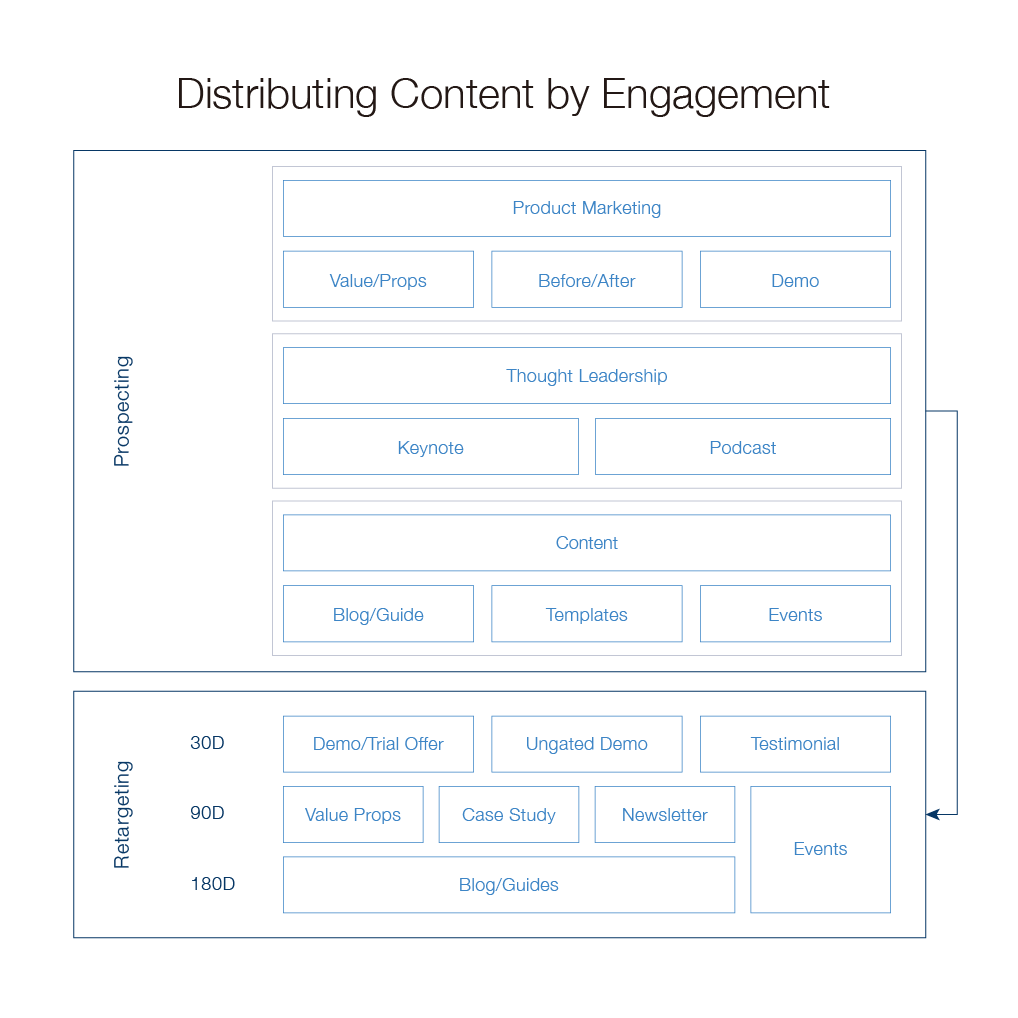
Mature content programs often see 40–60% of qualified leads originating from organic channels within 18–24 months of consistent execution. However, this timeline varies by competitive intensity, starting domain authority, and content volume.
Process overview:
|
Phase |
Timeline |
Key Activities |
|
Discovery |
Weeks 1–2 |
Stakeholder interviews, analytics review, ICP refinement |
|
Audit |
Weeks 2–4 |
Content inventory, competitive analysis, gap identification |
|
Strategy |
Weeks 4–8 |
Roadmap development, topic clustering, KPI definition |
|
Production |
Ongoing |
Content creation, SME interviews, editing, optimization |
|
Distribution |
Ongoing |
Publishing, promotion, social, email, PR |
|
Reporting |
Monthly/Quarterly |
Performance analysis, attribution, recommendations |
Core Process: From Discovery to Live Campaigns
Discovery and audit work creates the foundation for everything that follows. Skipping or rushing this phase leads to misaligned content that fails to drive business growth.
Discovery phase activities:
- Stakeholder interviews with founders, sales leaders, and customer success
- Review of 12–24 months of analytics data to identify patterns
- ICP refinement based on actual customer data, not assumptions
- Sales call analysis to extract recurring pain points and objections
- Competitive intelligence gathering
Content and SEO audit components:
- Complete inventory of existing content assets
- Performance scoring based on traffic, rankings, and conversions
- Gap analysis against competitor content
- Identification of quick wins (content refreshes, internal link improvements)
- Technical SEO baseline assessment
Roadmap prioritization framework:
- Start with high-intent topics closest to revenue (decision-stage keywords)
- Build out supporting content that addresses consideration-stage questions
- Expand to awareness-level educational content for pipeline building
- Include content refresh schedule for existing high-potential assets
Quality assurance before publication:
- Editorial review for clarity and readability
- Fact-checking for accuracy (critical in technical fields)
- SEO verification: keyword placement, internal links, meta data
- Brand voice alignment check
- Final approval workflow
Full-Funnel Content Strategy and Buyer Intent Alignment
Top content marketing agencies map content to buyer stages, ensuring coverage across the entire journey from awareness to decision.
Buyer stage content mapping:
|
Stage |
Intent |
Content Examples |
|
Awareness |
Problem-focused |
“What is zero trust security?” / “Signs your HVAC needs replacement” |
|
Consideration |
Solution comparison |
“7 ways to solve X problem” / “Choosing between A and B” |
|
Decision |
Product/ROI-focused |
“[Product] vs. [Competitor]: 2026 Comparison” / “ROI of implementing X” |
Keyword intent alignment:
- Informational keywords: Target with educational content that builds brand authority
- Commercial keywords: Target with comparison content and solution overviews
- Transactional keywords: Target with product pages and conversion-focused content
B2B-specific considerations:
- Create champion enablement content: PDF one-pagers, slide decks, ROI calculators that internal champions can share with buying committees
- Address multiple stakeholders: technical evaluators, financial decision-makers, end users
- Support long sales cycles with nurture content that maintains engagement
Concrete examples from enterprise brands:
- Industry leaders like Siege Media create pillar pages targeting competitive keywords that capture traffic across the entire topic cluster
- Agencies like Foundation Marketing develop research-driven content for global brands like Canva that positions clients as industry thought leaders
Optimization, Repurposing, and GEO (Generative Engine Optimization)
Content marketing doesn’t end at publication. Top agencies treat optimization as a continuous loop.
Ongoing optimization activities:
- Updating older posts with new data, examples, and internal links
- Improving CTAs based on conversion data
- Adding schema markup to capture featured snippets
- Refreshing headlines and meta descriptions for better click-through rates
- Expanding thin content that shows ranking potential
Measuring refresh impact:
- Track traffic and conversions 30/60/90 days before vs. after updates
- Monitor ranking changes for target keywords
- Document wins to justify continued optimization investment
Repurposing tactics for maximum reach:
- Turn a research report into: blog posts, LinkedIn threads, infographics, email series, and short-form videos
- Extract podcast or webinar content into written summaries and social clips
- Create slide decks from long-form guides for LinkedIn and SlideShare
- Build email nurture sequences around cornerstone content pieces
Generative Engine Optimization (GEO) for 2026:
As AI-powered search experiences become mainstream, structuring content for data driven seo strategies that work with AI systems matters more than ever.
GEO best practices:
- Clear, descriptive subheadings that answer specific questions
- Explicit answer formatting (direct statements, not buried in paragraphs)
- Concise Q&A sections that AI can easily extract
- Authoritative citations and links to trustworthy sources
- Structured data implementation for enhanced understanding
FAQs About Working with Content Marketing Agencies in 2026
This section addresses common questions about timelines, expectations, and how content marketing agencies differ from other marketing services providers.
1. How long does it take to see results from content marketing?
Expect early traffic movement in 3–4 months, meaningful lead generation in 6–9 months, and fully compounding effects in 12+ months for competitive industries. Content marketing is a long-term investment, agencies promising overnight results are red flags.
2. What’s the difference between content agencies, SEO agencies, and full-service digital agencies?
Content marketing agencies focus on strategy and content creation tied to business outcomes. An SEO agency focuses primarily on search visibility through technical optimization and link building. Full-service shops orchestrate across multiple channels including paid advertising, web design, and marketing automation.
3. What’s a typical contract length?
Most retainers require 3–12 month minimums. Six months is common for testing fit while allowing enough time to see meaningful results. Shorter contracts may be available for project work or established relationships.
4. What do clients need to provide?
Agencies typically need access to: analytics platforms (GA4, Search Console), CRM data for attribution, brand guidelines, competitor lists, access to subject-matter experts for interviews, and regular feedback on content quality and direction.
5. How involved do we need to be?
Plan for 2–4 hours per month minimum for reviews, approvals, and strategic discussions. Complex technical content or highly regulated industries may require more involvement for accuracy verification.
6. What should we expect in monthly reporting?
Strong agencies provide: traffic and ranking trends, content performance by piece, lead generation metrics, pipeline attribution where tracking allows, and recommendations for the upcoming period.
7. How much does a content marketing agency cost in 2026?
Content marketing agency retainers typically range from $3,000 to $15,000 per month for B2B companies, depending on content volume, channel coverage, and strategy depth. Full-service agencies that handle SEO, content creation, distribution, and reporting sit at the higher end. Per-project pricing for a single content audit or campaign brief typically runs $2,500 to $10,000. The most important number is not the monthly fee but the cost per qualified lead attributed to content - agencies that track this give you a far clearer picture of ROI than those reporting purely on traffic and rankings.
8. What content formats drive the most ROI for B2B companies in 2026?
Long-form SEO articles targeting bottom-of-funnel keywords consistently outperform short-form content for B2B lead generation because they capture buyers who are actively researching solutions. Comparison pages, alternative pages, and use-case specific landing pages convert at 3 to 5 times the rate of general educational content. Video content drives strong engagement but requires a clear distribution strategy to generate pipeline, YouTube SEO and LinkedIn video perform best for B2B. Interactive tools like calculators, assessments, and configurators are increasingly being used by top agencies to capture intent signals and qualify leads directly from content.
9. Should we work with a specialist content agency or a full-service digital agency?
Specialist content agencies tend to produce higher-quality editorial output and have deeper expertise in content strategy, SEO, and narrative development. Full-service agencies offer the advantage of coordinating content with paid media, CRO, and marketing automation in one place, which reduces handoff friction. For companies whose primary growth lever is organic search and thought leadership, a specialist content agency usually delivers better results. For companies running multi-channel campaigns where content needs to feed paid, email, and social simultaneously, a full-service agency or hybrid model tends to be more efficient.
Next Steps: How to Shortlist and Hire a Content Marketing Agency This Quarter
Finding the best content marketing agency for your business requires preparation and structured evaluation. Here’s what to do in the next 30 days:
Immediate action items:
- Define 3–5 measurable goals with specific numbers and timeframes
- Document your budget range (monthly minimum, ideal, and maximum)
- Assemble your ICP documentation and key messaging frameworks
- Ensure analytics access is in order (GA4, Search Console, CRM)
- Draft an RFP or requirements document outlining scope and expectations
Evaluation approach:
Send a short brief to 3–5 agencies, then compare proposals based on:
- Strategy depth and approach, not just deliverable counts
- Fit with your specific industry and growth stage
- Pricing transparency and alignment with your budget
- Reporting methodology and attribution approach
- Team composition and who will actually work on your account
Before committing long-term:
Consider running a paid pilot project or 90-day engagement with clear KPIs before signing a 12-month contract. This reduces risk and validates fit before larger investments.
The right agency acts as a strategic partner, asking hard questions, challenging assumptions, and tying every content initiative back to revenue and long-term business growth.
Choose an agency that demonstrates genuine curiosity about your business, shows relevant experience in your industry, and measures success the same way you do: through measurable growth in pipeline and revenue, not just traffic and rankings.
Content marketing agencies have matured significantly in 2026. The competitive advantage now goes to organizations that invest in the right partnerships early, building content engines that compound month over month while reducing dependence on expensive paid channels. Start your search this quarter, and position your brand for sustainable organic traffic growth.
Content Marketing Agency Partnerships: Collaboration Models and Long-Term Value
Successful content marketing agency partnerships are built on a foundation of collaboration, transparency, and shared objectives. In 2026, the most effective marketing agencies act as true strategic partners, working closely with clients to align content creation with broader marketing strategies and business goals. This collaborative approach goes beyond transactional relationships, agencies and clients engage in regular communication, strategic planning sessions, and ongoing feedback loops to ensure every piece of content supports lead generation, customer acquisition, and brand growth.
A strong partnership means agencies gain a deep understanding of the client’s brand voice, target audience, and unique value proposition. This enables the creation of high quality content that resonates across social media marketing channels, supports search engine optimization, and drives measurable website traffic. Agencies also bring expertise in link building and data driven SEO strategies, ensuring that content not only attracts attention but also ranks well in search engines and converts visitors into leads.
Long-term value emerges when both parties invest in the relationship: agencies proactively suggest new marketing strategies, optimize content based on performance data, and adapt to changing market conditions. Clients, in turn, provide timely feedback, access to subject-matter experts, and clear business objectives. This synergy results in a steady stream of quality content, improved social media engagement, and sustained growth in qualified leads and customer acquisition. Ultimately, the right content marketing agency partnership delivers compounding returns, turning content into a core driver of business success.
Content Marketing Trends Shaping Agencies in 2026
The content marketing landscape in 2026 is defined by rapid innovation and evolving consumer expectations. Top content marketing agencies are embracing new technologies and creative approaches to stay ahead. Artificial intelligence (AI) now plays a central role in content creation, enabling agencies to produce personalized, data-driven content at scale. AI-powered tools help identify trending topics, optimize for search intent, and even generate first drafts, freeing up human creators to focus on strategy and storytelling.
Voice search optimization is another major trend, as more users interact with brands through smart speakers and voice assistants. Agencies are adapting content marketing services to ensure content is discoverable and engaging in these new formats. Video content, especially short-form videos, continues to dominate social media and multiple channels, with agencies investing in high-quality production to capture and engage target audiences quickly.
Sustainability and ethical marketing are also shaping agency practices. There’s a growing emphasis on transparency, authenticity, and environmental responsibility in marketing campaigns. Agencies are helping brands build trust by prioritizing honest messaging and responsible content creation. By leveraging these trends, AI, voice search, immersive video, and ethical marketing, content marketing agencies provide innovative marketing services that drive measurable growth and keep clients ahead of the competition.
Content Marketing Agency Challenges: What to Watch Out For
While content marketing offers significant rewards, both agencies and their clients face persistent challenges in 2026. One of the biggest hurdles is accurately measuring the ROI of content marketing efforts. Unlike paid campaigns with immediate results, the impact of content creation often unfolds over months, making it difficult to attribute revenue directly to specific pieces of content.
Producing high-quality, engaging content that stands out in a saturated market is another challenge. As more businesses invest in content marketing, agencies must work harder to create unique, valuable assets that truly resonate with the target audience. This requires a deep understanding of audience needs, ongoing research, and a commitment to quality over quantity.
Agencies must also stay agile in response to frequent changes in search engine algorithms and social media platform policies. These shifts can impact content visibility and distribution, requiring constant adaptation and the use of data driven SEO strategies to maintain strong performance. Increased competition means that simply publishing content is no longer enough, agencies must focus on long-term strategy, continuous optimization, and creative approaches to reach and engage audiences on social media and beyond.
By recognizing these challenges and proactively addressing them, content marketing agencies can deliver sustained value and help clients achieve their business goals.
Content Marketing Agency Opportunities: Where the Smart Money Is Going
The future of content marketing is rich with opportunity for agencies willing to innovate and expand their service offerings. AI-powered content creation tools are transforming the industry, enabling agencies to streamline workflows, personalize messaging, and scale content production without sacrificing quality. This technology allows for more efficient ideation, editing, and optimization, freeing up creative teams to focus on strategy and storytelling.
Specialized content marketing services are in high demand, particularly in areas like technical SEO, link building, and digital PR. As businesses seek to boost their online authority and search visibility, agencies that offer these advanced marketing services are well-positioned for growth. Digital PR, in particular, helps brands secure high-value backlinks and media coverage, amplifying the impact of their content marketing efforts.
The rise of voice search and smart speakers presents new frontiers for content marketing. Agencies are developing content optimized for voice queries and exploring interactive, voice-activated experiences that engage users in novel ways. By investing in these emerging areas and expanding their service offerings, content marketing agencies can attract new clients, drive revenue growth, and maintain a competitive edge in a rapidly evolving market.
Smart investors are taking note, channeling resources into agencies and technologies that prioritize innovation, technical expertise, and measurable results.
Content Marketing Agency Best Practices for 2026
To thrive in the competitive content marketing landscape of 2026, agencies must adhere to a set of best practices that ensure consistent, measurable results. The foundation is a comprehensive content marketing strategy that aligns with the client’s business objectives and is tailored to the needs of the target audience. This strategy should be informed by data driven SEO strategies, ensuring that every piece of content is optimized for organic traffic and search engine visibility.
Quality is paramount, agencies must prioritize high-quality, relevant, and engaging content that addresses real audience pain points and drives meaningful interactions. Ongoing content optimization, informed by performance data and analytics, is essential for maintaining and improving search rankings over time.
Transparency and authenticity are also critical. Agencies should communicate openly with clients, provide clear reporting on measurable results, and ensure all marketing activities are ethical and sustainable. By fostering trust and accountability, agencies build long-term relationships that support business growth.
Ultimately, the best content marketing agencies in 2026 are those that combine strategic vision, creative excellence, and technical expertise to deliver organic traffic, qualified leads, and measurable business outcomes for their clients.
Benefits of Hiring a Content Marketing Agency
Partnering with a content marketing agency unlocks a range of strategic advantages that can accelerate business growth and deliver measurable results. In today’s competitive digital landscape, the right content marketing agency acts as an extension of your team, bringing specialized expertise, proven processes, and the latest marketing strategies to the table.
Here’s how businesses benefit from hiring a content marketing agency in 2026:
- Accelerated Brand Awareness and Authority: Agencies excel at creating high quality content that positions your brand as an industry leader. Through targeted blog content, thought leadership, and digital PR, they help you build credibility and trust with your target audience across multiple channels.
- Improved Search Engine Optimization (SEO): With deep knowledge of technical SEO, keyword strategies, and link building, agencies ensure your content ranks for competitive keywords and drives sustainable organic traffic. Their data driven SEO strategies keep your brand visible in search engines, even as algorithms evolve.
- Enhanced Lead Generation and Conversion: By aligning content creation with your buyer’s journey, agencies generate qualified leads and nurture them through conversion rate optimization, email marketing, and marketing automation. This results in a predictable pipeline and measurable growth in customer acquisition.
- Comprehensive Content Marketing Strategy: Agencies develop tailored, end-to-end content marketing strategies that integrate content creation, social media marketing, and paid advertising. This holistic approach ensures every piece of content supports your broader business objectives and marketing campaigns.
- Access to Specialized Talent and Tools: Content marketing agencies provide a team of experienced professionals, writers, strategists, SEO experts, designers, and social media managers, who stay ahead of digital marketing trends. They leverage advanced analytics, performance marketing platforms, and web development resources to maximize your ROI.
- Resource Efficiency and Scalability: Outsourcing to an agency frees up your internal team to focus on core business functions, while the agency manages the content creation process, social media management, and campaign execution. This allows you to scale your marketing efforts without expanding headcount.
- Measurable Outcomes and Transparent Reporting: Top content marketing agencies provide clear key performance indicators, regular reporting, and ROI tracking. You gain visibility into website traffic, lead generation, social media engagement, and revenue impact, enabling data-driven decision making.
- Agility and Innovation: Agencies are quick to adapt to changes in search visibility, social media algorithms, and emerging platforms like voice search and AI-driven content. Their proactive approach ensures your marketing strategies remain effective and competitive.
Share this
Subscribe
Recent Posts
NEED TO INCREASE REVENUE?
Improve Your Marketing ROI
Let’s talk and see how we can help you scale a steady stream of new leads, customers and revenue.
