
Last Updated: August, 2026 | 7 minute read

Account based marketing services help B2B companies win and expand high value accounts by combining strategy, data, and technology into coordinated programs. These services deliver account based marketing programs, a structured, strategic approach that ensures clear personalization, systematic sales-marketing alignment, and measurable ROI. Unlike traditional demand generation that casts a wide net, these ABM services focus your marketing investment on a defined list of target accounts and buying committees, the specific decision makers who influence purchasing.
Effective ABM services integrate tightly with sales teams, leverage platforms like Demandbase, Propensity, 6sense, and Salesforce utilize ABM tools as essential software platforms for targeting, personalization, automation, content delivery, and analytics in ABM. Modern ABM tools are increasingly powered by artificial intelligence, which enhances account identification, personalization, and automation to improve marketing effectiveness. These services typically demonstrate measurable ROI within 6 to 12 months.
What makes these ABM agency services valuable is their comprehensive scope. They span strategy development, data enrichment, technology configuration, personalized campaigns, and ongoing optimization rather than one-off campaign execution. The rest of this article walks through what ABM is, key benefits, service types, the essential tech stack, implementation steps, and how to choose the right provider for your organization.
Key Takeaways
- Account based marketing services transform a list of strategic accounts into structured programs covering research, personalized messaging, multi-channel campaigns, and rigorous measurement
- ABM services work across three primary models, 1:1 for top-tier accounts, 1:few for industry clusters, and 1:many for scaled personalization, allowing flexible resource allocation
- Successful ABM requires tight alignment between marketing and sales teams, shared KPIs, and regular pipeline reviews to adjust tactics based on deal feedback. These elements are critical for account based marketing success, as they ensure strategic planning and effective execution.
- Most organizations start with a 60-90 day pilot focused on 20-50 accounts before scaling to broader programs across regions and product lines
- The right ABM services partner brings strategic depth, vertical experience, and the ability to build internal capabilities rather than creating long-term dependency
What Are Account Based Marketing Services?
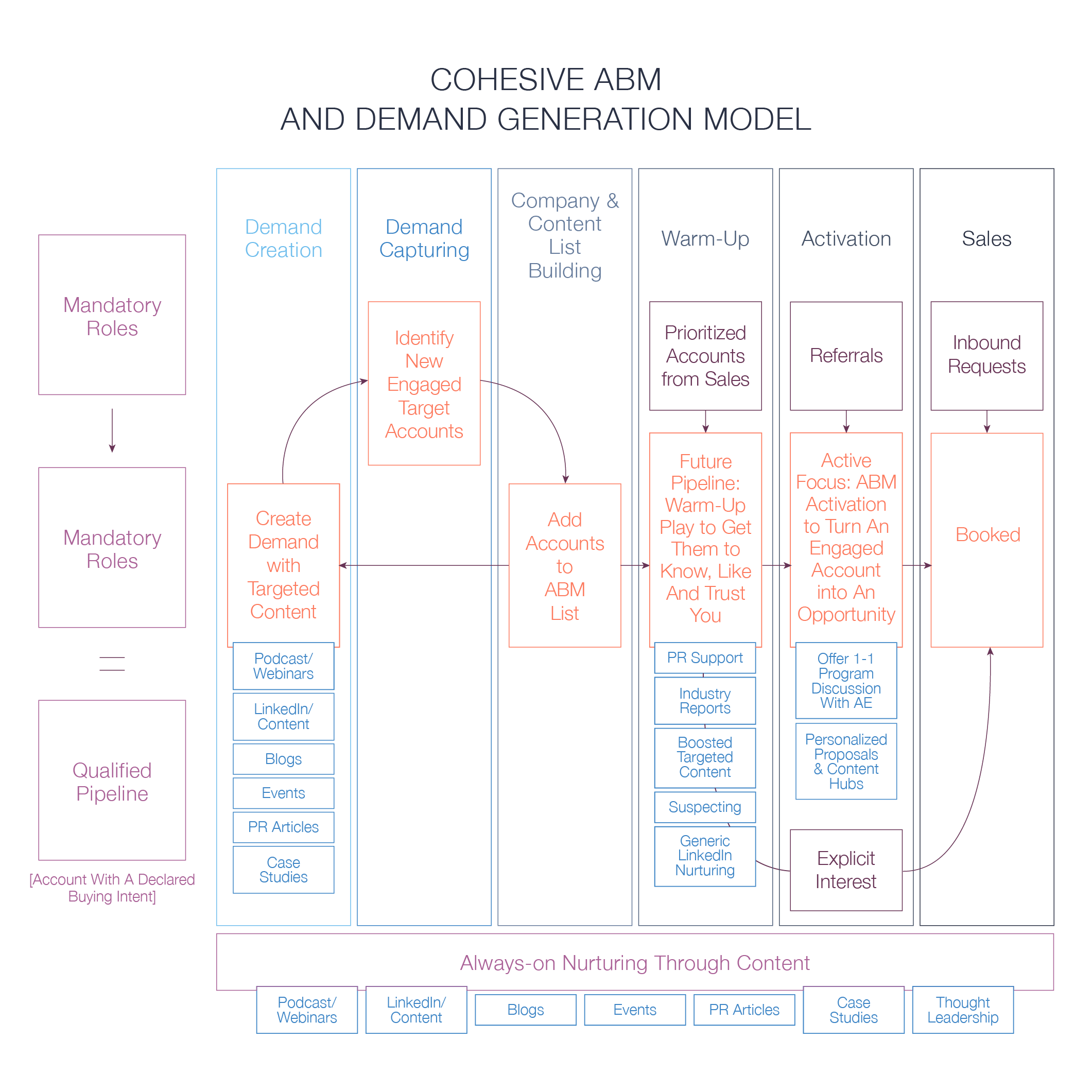
Account based marketing services are specialized B2B marketing offerings that design and run highly targeted programs for named accounts. These services operate across three core models: 1:1 programs for your most valuable accounts requiring deep personalization, 1:few programs for clusters of 5-15 similar accounts sharing industry challenges, and 1:many programs using technology for scaled personalization across hundreds of specific accounts.
These services turn a list of key accounts into structured programs covering account research, message development, campaign execution, and performance measurement. The fundamental shift is treating each account as a “market of one” rather than chasing broad lead volume. Account based marketing services help identify and engage potential customers who are most likely to benefit from your solutions, using strategies like intent data analysis and targeted outreach.
Understanding the “market of one” approach:
- Each target account receives customized attention based on its specific business challenges, industry context, and buying committee composition
- Buying committees in 2026 enterprise technology deals typically include the CIO, CISO, CFO, and line-of-business executives, each requiring tailored messaging
- Account based marketing ABM focuses on expanding influence across these stakeholders rather than generating individual leads
- Programs address the entire sales cycle from initial awareness through closed deals and customer expansion
ABM services usually sit on top of your existing CRM and marketing automation platform rather than replacing them. Providers configure these systems to support account-level tracking, engagement scoring, and coordinated outreach. Services can be project-based, such as a 90-day pilot to prove concept, or ongoing managed programs covering hundreds of accounts with continuous optimization.
How Account Based Marketing Services Work
Account based marketing operates as a repeatable cycle: identify the right accounts, engage key decision makers, convert opportunities to revenue, and expand relationships within existing customers. ABM services providers bring structure, expertise, and execution capacity to each phase of this cycle. Lead generation is integrated throughout the ABM process by capturing interest and leads within targeted accounts, ensuring that engagement efforts directly support pipeline growth and revenue goals.
High-level phases of ABM service delivery:
|
Phase |
Key Activities |
Typical Duration |
|---|---|---|
|
Account Selection & ICP Definition |
Analyze historical wins, define firmographic criteria, build prioritized account list |
2-4 weeks |
|
Insight & Research |
Gather intent data, map buying committees, identify account-specific pain points |
2-3 weeks |
|
Program Design |
Develop messaging frameworks, content assets, channel strategies, and sales plays |
3-4 weeks |
|
Multi-Channel Execution |
Launch targeted campaigns across ads, email, SDR outreach, events, and web personalization |
Ongoing |
|
Analytics & Optimization |
Track engagement, attribute pipeline, refine targeting based on results |
Continuous |
Services coordinate many execution channels to ensure contacts at target accounts see coherent messages. Effective B2B messaging services are the layer that makes those messages feel personal and relevant rather than generic at scale. This includes account based advertising on LinkedIn and programmatic display, email nurture sequences, SDR outreach, executive events, personalized direct mail, and website personalization for visitors from key accounts.
ABM providers don’t operate in isolation from your revenue team. They regularly meet with sales leadership, often in weekly pipeline reviews, to adjust plays based on live deal feedback. When a key account shows buying signals, the program shifts to accelerate engagement. When deals stall, messaging and channel mix get refined.
Mature ABM programs create documented playbooks per segment or tier of accounts. A Tier 1 account in financial services gets a different treatment than a Tier 2 account in manufacturing, but both follow repeatable frameworks that make activity scalable and consistent across your organization.

Core Types of Account Based Marketing Services
ABM services typically combine several specialized workstreams that work together to drive engagement data, pipeline, and revenue from your most significant accounts. While comprehensive programs include all of these elements, many providers also offer them à la carte based on your current needs and capabilities.
Most B2B companies start with a strategic engagement with ABM agencies lasting 8-12 weeks to define their ABM strategy, build their target account list, and design initial programs. They then move into managed ABM services for ongoing execution and optimization.
Primary service categories:
- Strategy and Planning: ICP development, account segmentation, tier definitions, and goal-setting workshops
- Data and Analytics: Account identification, intent signal analysis, contact enrichment, and engagement scoring
- Campaign Execution: Creative development, multi-channel orchestration, and personalized content delivery, including targeted marketing campaigns that coordinate, deliver, and track personalized efforts to specific prospects for enhanced sales opportunities
- Sales Enablement: Account dossiers, talk tracks, email templates, and collaboration processes
- Reporting and Optimization: Dashboard development, attribution modeling, and continuous program refinement
ABM Strategy and Planning Services
ABM Strategy services help you define your ideal customer profile, segment accounts into actionable groups, and choose the right ABM tiers based on account value and your capacity to serve them. This foundational work determines whether your marketing efforts hit the right accounts with the right messages.
Workshops with marketing teams, sales teams, and customer success bring together diverse perspectives to align on goals. Achieving strong marketing alignment in these sessions is crucial for developing an effective ABM strategy, as it ensures that sales and marketing teams are synchronized around shared objectives and cohesive tactics. These sessions typically establish pipeline targets, deal size expectations, and retention objectives for the next 12 months.
Typical strategy service deliverables:
- Account selection framework with scoring criteria weighted by revenue potential, fit, and likelihood to buy
- Prioritized target account list validated by sales leadership
- Documented value propositions by vertical (manufacturing, SaaS, financial services, healthcare)
- ABM tier definitions specifying which accounts get 1:1, 1:few, or 1:many treatment
- Governance structures defining who owns account relationships and how programs get reviewed
- Quarterly plans and annual account coverage models showing resource allocation
Planning services establish realistic horizons for your ABM programs. A well-constructed plan acknowledges that meaningful engagement takes time, especially for enterprise deals with 6-12 month sales cycles.
ABM Data, Insights, and Target Account Selection
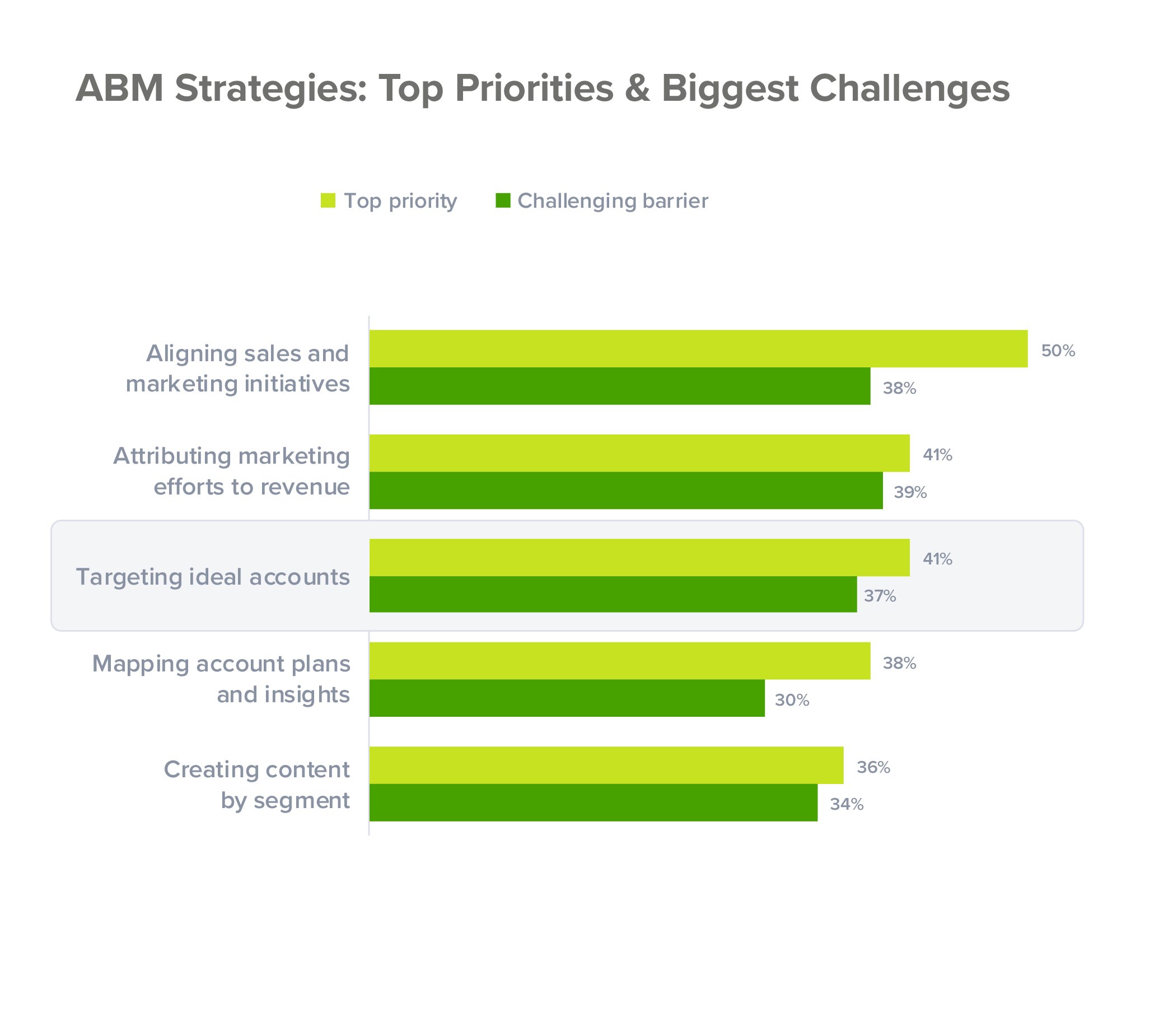
Rigorous account selection is foundational to ABM program ROI. This phase uses customer data from your CRM, firmographic data (revenue, employee count, geography, technology stack), and intent data to rank and prioritize accounts.
Services analyze your historical wins from 2020-2025 to identify patterns in successful deals. Which industries convert best? What company sizes yield the highest contract values? What triggers typically precede a purchase decision? These insights shape your ideal customer profile and guide where to focus marketing resources.
Tools commonly used in account selection:
- Intent data platforms: Bombora, TechTarget Priority Engine reveal which accounts are actively researching topics relevant to your solutions
- Contact enrichment: ZoomInfo, Clearbit fill gaps in buying committee data including titles, direct emails, and organizational structures
- Technographic data: Platforms that identify target accounts based on current technology installations
Using intent data and contact enrichment tools is essential for reaching target accounts with personalized and timely engagement, ensuring your ABM efforts connect with the right decision-makers at the right moment.
Providers create tiered account lists that match your capacity:
|
Tier |
Account Count |
ABM Model |
Investment Level |
|---|---|---|---|
|
Tier 1 |
10-25 accounts |
1:1 |
High-touch, fully custom programs |
|
Tier 2 |
50-150 accounts |
1:few |
Cluster-based personalization by vertical |
|
Tier 3 |
500+ accounts |
1:many |
Scaled personalization with technology |
The most successful ABM programs revisit their target account lists quarterly, removing accounts that have disqualified and adding emerging opportunities that match the ICP.
ABM Campaign Design and Creative Services
Campaign design services turn account insights into concrete campaign concepts and playbooks that drive meaningful engagement. This work bridges strategy and execution, ensuring your creative assets and messages resonate with specific buyer personas at each stage of the sales process.
Typical assets developed for ABM campaigns:
- Personalized landing pages that speak directly to industry challenges
- Vertical-specific eBooks and research reports
- Webinar series addressing common pain points in target segments
- ROI calculators customized to account-specific variables
- Executive briefing decks for 1:1 account outreach
- Video content featuring customer success stories from similar organizations
Strong ABM creative services tailor messaging by persona and buying stage. A CFO in the awareness stage sees different content than a CIO evaluating solutions. A VP of Operations deep in consideration receives different messaging than an IT director just beginning research. Personalized engagement is achieved by delivering tailored content and interactions for each account, ensuring every touchpoint is relevant and meaningful to the specific needs and interests of high-value targets.
Services develop content calendars, channel mix recommendations, and message matrices mapped to each account segment. Personalization ranges from simple industry tokens in email subject lines to fully bespoke 1:1 microsites for your top strategic accounts, complete with account-specific case studies and tailored value propositions.
Multi-Channel ABM Execution and Orchestration
This is where ABM services actually run coordinated programs against your target accounts. Effective orchestration ensures that contacts at key accounts see consistent, coherent messages across every touchpoint, whether they’re clicking a display ad, receiving an SDR email, or visiting your website. This level of coordination helps shorten sales cycles by accelerating engagement and moving deals forward more quickly with high-value clients.
Channels typically orchestrated in ABM programs:
- LinkedIn advertising targeting specific job titles at target companies
- Programmatic display reaching accounts showing intent signals
- Email sequences personalized by account, vertical, and persona
- SDR outreach aligned with marketing campaigns
- Executive events and roundtables for strategic accounts
- Direct mail for high-value 1:1 programs
- Website personalization showing relevant content to account visitors
Services use marketing automation platforms like HubSpot, Marketo, or Pardot tied to CRM systems like Salesforce to manage this orchestration. The technology handles sequencing, but the strategy determines what happens when.
Campaign operations support includes list management, quality assurance, tracking link setup, and technical troubleshooting. ABM services maintain strict timelines and SLAs with sales to ensure that when an account engages, the follow-up happens immediately. Execution typically runs in regular sprints, often two-week cycles, with clear deliverables and review checkpoints.
Sales Enablement and Revenue Team Alignment
ABM services enable SDRs and account executives to act on the marketing signals generated by targeted campaigns. For revenue operations leaders managing that alignment, 310 Creative's revenue operations solution outlines how ABM programs integrate with CRM and pipeline workflows. Without this connection, even the best marketing campaigns fail to convert to pipeline and revenue.
Deliverables for sales teams:
- Account dossiers with company background, key initiatives, and recent news
- Talking point sheets addressing persona-specific pain points
- Email templates customized by account tier and vertical
- Call scripts with discovery questions and objection handling guides
- Personalized content libraries sales can share during the sales cycle
Processes matter as much as assets. Effective ABM services establish weekly “account standups” where marketing and sales teams review engagement data and agree on next best actions for priority accounts. If an account downloads a whitepaper and attends a webinar, what should the SDR do next? These playbooks turn marketing efforts into sales meetings.
Strong services track which plays sales actually uses and refine enablement assets based on win/loss feedback. When marketing and sales efforts operate from one shared plan, the impact shows in higher win rates, faster deal velocity, and more expansion opportunities within existing customers.

Measurement, Analytics, and Optimization Services
ABM measurement operates at the account and program level, not just the lead level. This shift is fundamental. Success means engaging and converting entire buying committees, not just generating form fills.
Key performance indicators for ABM programs:
|
Metric Type |
Examples |
Timing |
|---|---|---|
|
Leading Indicators |
Account engagement score, content downloads, website visits from target accounts |
Weekly |
|
Mid-Funnel Metrics |
Marketing qualified accounts, sales meetings booked, opportunities created |
Monthly |
|
Lagging Indicators |
Pipeline value, closed-won revenue, average contract value, win rate |
Quarterly |
Services build dashboards, typically in Salesforce, Power BI, or Tableau that slice performance by segment, campaign, and tier. These dashboards give visibility into which programs drive results and which need adjustment.
Account based analytics runs regular tests on subject lines, offers, creative, and channels. Results feed back into targeting and messaging decisions. Optimization cycles operate monthly with tactical adjustments and quarterly with strategic reviews. Multi-quarter learning accumulates as programs mature, what worked for one vertical may not work for another, and ABM services help you build this institutional knowledge.
Benefits of Working with an ABM Services Partner
Specialist ABM partners help companies avoid false starts and accelerate ABM maturity. Building these capabilities from scratch internally takes years; working with experienced providers compresses that timeline significantly.
Key benefits of partnering with ABM services providers:
- Faster time-to-value: Proven frameworks mean you’re running effective campaigns in weeks, not quarters
- Deeper expertise: Access to specialists in account identification, content marketing, and demand generation
- Better tech utilization: Partners extract more value from tools you may already own but underuse
- Stronger sales alignment: External partners often facilitate difficult conversations between marketing and sales teams
- Risk reduction: Proven approaches reduce wasted spend on poorly targeted campaigns
Data across the industry shows that ABM programs typically deliver 3-5x higher conversion rates on target accounts compared to non-ABM approaches. Average contract values increase when you engage entire buying committees rather than individual leads. By leveraging expert guidance, organizations significantly improve their chances of running a successful ABM campaign that delivers measurable results.
Good partners leave clients with processes and playbooks, not dependency. The goal is building internal capability over time while delivering results in the near term.
Marketing and Sales Alignment Gains
ABM partners facilitate cross-functional workshops that establish shared KPIs and common definitions. What qualifies as a “target account”? When does an account move from marketing to sales ownership? These conversations happen early and get documented.
Services implement joint dashboards so both teams see the same account engagement and pipeline metrics. When marketing and sales teams view identical data, finger-pointing decreases and collaboration increases.
Cultural benefits of alignment:
- Reduced friction between teams about lead quality and follow-up timing
- Clearer ownership of account relationships at each stage
- More confident executive reporting on revenue outcomes tied to marketing investment
- Shared celebration when key accounts close
Consider a mid-market SaaS company aligning their VP of Sales and CMO around 100 strategic accounts. With a shared dashboard showing engagement scores and pipeline progress, both leaders can focus conversations on tactics rather than disputes about whether marketing is delivering value.
Alignment benefits compound over time. The initial campaign wave drives results, but sustained ABM success requires ongoing coordination that alignment practices enable.
ROI, Deal Size, and Sales Cycle Impact
Successful ABM campaigns deliver concrete commercial results. Organizations report significantly higher sales win rates for accounts in ABM programs compared to non-ABM opportunities. Deal sizes increase when programs engage multiple stakeholders across the buying committee.
Directional outcomes from ABM programs:
- Win rates often improve substantially when comparing ABM to non-ABM opportunities
- Average contract values increase as programs engage CFOs and CIOs alongside technical buyers
- Sales cycles shorten when accounts receive consistent, relevant messaging before engaging sales
- Customer acquisition costs can decrease despite higher per-account investment due to improved conversion rates
Focusing on well-qualified accounts reduces time wasted on low-fit leads. Sales teams spend more hours on opportunities likely to close, compressing decision timelines and improving quota attainment.
Upsell and cross-sell motions into existing customers often become a core part of ABM services. The same “market of one” approach that wins new logos works equally well for expanding relationships with key customers, driving customer loyalty and lifetime value.
Key Account Based Marketing Tools Used by Service Providers
ABM services rely on a defined MarTech stack, but providers are rarely locked to any single vendor. The goal is better targeting high value accounts, more relevant personalization, and more accurate measurement of what’s working.
Tools fall into several categories based on their role in ABM programs:
|
Category |
Purpose |
Example Platforms |
|---|---|---|
|
Core ABM Platforms |
Account targeting, scoring, orchestration |
Demandbase, 6sense, Terminus, RollWorks |
|
Intent Data |
Surface accounts researching relevant topics |
Bombora, TechTarget Priority Engine |
|
Contact Enrichment |
Fill gaps in buying committee data |
ZoomInfo, Clearbit, Apollo |
|
Marketing Automation |
Execute and track personalized campaigns |
HubSpot, Marketo, Pardot |
|
Communication |
Engage visitors and route conversations |
Drift, Intercom, Qualified |
|
Content Delivery |
Personalized content experiences |
PathFactory, Uberflip |
Agencies typically integrate with existing client tools rather than forcing a rip-and-replace in year one. Providers also bring their own reporting and workflow tools to coordinate distributed teams and stakeholders.
Core ABM Platforms
Major account-based marketing tools like Demandbase, 6sense, Terminus, and RollWorks serve as hubs for account targeting, scoring, and orchestration. These platforms aggregate signals from multiple sources to give you a unified view of account engagement.
Capabilities of core ABM platforms:
- Account-level analytics showing engagement across all contacts at a company
- Website personalization that displays relevant content to visitors from target accounts
- Account based advertising that serves display ads specifically to people at your target companies
- Intent signals that identify accounts researching topics relevant to your solutions
- Integration with CRM and marketing automation for unified data
Service providers help configure segments within these platforms, set up automated playbooks triggered by engagement thresholds, and interpret the intent and engagement signals they generate.
Platform choice depends on company size, data maturity, and regional focus. A global enterprise with complex buying committees may need different capabilities than a mid-market company targeting 200 accounts in North America.
Tools are enablers of the ABM strategy, not the strategy itself. The best platform poorly configured delivers worse results than a modest platform expertly implemented.
Intent Data and Contact Enrichment Tools
Intent tools like Bombora and TechTarget Priority Engine surface accounts actively researching topics related to your solutions. If a company’s employees are reading content about “cloud security transformation,” that signals potential interest in related offerings.
Contact enrichment tools like ZoomInfo and Clearbit help fill gaps in your buying committee data. You may know a company is a target, but you need names, titles, and direct contact information for key decision makers, the CIO, CISO, CFO, and business line leaders who influence purchases.
Using intent and enrichment together:
- Intent data identifies which accounts to prioritize this week
- Enrichment data identifies who to reach at those accounts
- Combined, they enable timely, personalized outreach to the right people when buying interest is highest
This combination is particularly important for complex, high-ticket B2B sales cycles where timing matters and buying committees include 6-10 stakeholders. Gaining insights into what accounts are researching, and who’s involved in decisions dramatically improves campaign effectiveness.
Privacy, compliance, and data accuracy remain considerations. Reputable providers work within GDPR and CCPA frameworks and maintain high data quality standards through regular verification.
Communication and Content Delivery Platforms
Platforms like Drift enable conversational marketing through chat experiences tailored to visitors from target accounts. When someone from a Tier 1 account lands on your website, they can receive a personalized greeting and immediate routing to an account executive.
Content experience tools like Uberflip and PathFactory create personalized resource hubs for different account segments. Rather than sending a prospect to a generic resources page, ABM services configure these tools to show content curated for their industry, role, and buying stage.
Capabilities for ABM content delivery:
- Dynamic content that changes based on account firmographics or behavior
- Personalized resource hubs with vertical-specific case studies and guides
- Contextual chat playbooks tied to specific account segments
- Integration with analytics and CRM so engagement is properly attributed to accounts
These platforms close the loop between digital assets and account engagement data. When a target account spends 15 minutes consuming content about your enterprise solution, that signal should flow back to the CRM and trigger appropriate follow-up.

Implementing Account Based Marketing Services: Step-by-Step
Successful ABM service engagements follow a phased implementation rather than a big-bang launch. Rushing to execute campaigns before strategy and alignment are in place leads to wasted marketing resources and disappointed sales teams.
A proven ABM approach follows this sequence: discovery and audit, strategy and ICP definition, pilot design, execution, measurement, and scale-up. Most organizations benefit from a 60-90 day pilot focused on a limited set of accounts to prove concept and refine the model before broader investment.
Timelines need to factor in your sales cycle length. If enterprise deals typically take 9-months to close, expecting significant closed revenue in 90 days isn’t realistic. Many B2B firms should expect meaningful revenue signals within 2-3 quarters of launching ABM programs.
Phase 1: Discovery and ABM Readiness Assessment
This phase involves reviewing your current pipeline data, technology stack, content library, and organizational alignment. Consultants gain insights into what’s working, what’s broken, and what capabilities need building.
Assessment activities include:
- CRM data audit to evaluate account coverage and data quality
- Marketing automation review to understand current campaign capabilities
- Content inventory to assess personalization readiness
- Stakeholder interviews with sales, marketing, operations, and customer success
- Technology integration mapping to identify connection gaps
Readiness assessments often uncover realistic obstacles: incomplete CRM data that hampers targeting, fragmented regional teams that complicate orchestration, or misalignment between sales and marketing on what constitutes a qualified opportunity.
Assessment outputs include a readiness scorecard and prioritized recommendations for people, process, and technology investments. This phase typically takes 2-4 weeks and sets realistic expectations for what can be achieved in the first 6-12 months.
Phase 2: ICP, Segmentation, and Target Account List Creation
This phase analyzes your historical closed-won deals by industry, company size, use case, and deal characteristics to shape your ideal customer profile. What do your best customers have in common? Those patterns guide where to focus ABM efforts.
Service providers layer in third-party data like firmographics, intent signals, technographics, alongside leadership priorities to build a prioritized account universe. The resulting list isn’t just names; it’s a segmented, tiered framework for resource allocation.
Account list development process:
- Analyze 2-3 years of closed-won deals for firmographic and behavioral patterns
- Define ICP criteria with explicit inclusion and exclusion rules
- Identify target accounts using data platforms and internal knowledge
- Tier accounts based on fit score, deal size potential, and relationship status
- Validate with sales leadership to ensure buy-in and realistic coverage capacity
Disciplined segmentation here underpins all later personalization and measurement. If you’ve targeted the wrong accounts, even brilliant campaigns won’t deliver business growth.
Account lists should be revisited periodically, typically semi-annually or annually, as markets shift and your understanding of ideal customers deepens.
Phase 3: Pilot ABM Program Design and Launch
A focused pilot might target a specific region, vertical, or product line with 20-50 individual accounts. The goal is proving the model works before committing significant resources to broader rollout.
Elements of pilot program design:
- Clear goals tied to pipeline and engagement metrics
- Defined audience with explicit account and persona targeting
- Message themes addressing specific pain points identified in research
- Channel mix balancing reach and personalization depth
- Cadence specifying when and how often touchpoints occur
- Measurement plan with leading and lagging indicators
For the pilot, services create a focused set of digital assets: perhaps a vertical-specific landing page, an executive brief, a few personalized email sequences, and coordinated SDR outreach scripts. Sales plays get documented so reps know exactly how to follow up on marketing-driven engagement.
Pilots should be time-bound (typically 90 days) with clearly defined checkpoints for mid-course corrections. Weekly reviews during the pilot identify what’s working and what needs adjustment.
Learnings from the pilot drive decisions about budget, headcount, and scope for broader rollout. If the pilot shows strong engagement and pipeline creation, the case for scaling is clear.
Phase 4: Scaling and Optimizing ABM Services
After proving the model works, ABM services expand coverage to more accounts, regions, and product offerings. What worked for 50 accounts in financial services can potentially extend to 150 accounts across three verticals.
Scaling activities include:
- Building repeatable playbooks for each account tier and segment
- Creating standardized templates for common content types
- Establishing governance defining roles, review processes, and escalation paths
- Expanding to additional channels and touchpoints
- Training additional team members on ABM processes
Optimization continues even as programs scale. For top-tier accounts, personalization deepens with more customized content and 1:1 engagement. For lower tiers, marketing automation handles more of the execution while maintaining relevance.
Mature ABM programs often integrate customer marketing and expansion plays into the same framework. The accounts you’ve won become targets for upsell, cross-sell, and advocacy development, driving customer loyalty alongside new customer acquisition.
Continuous skills development keeps internal teams capable of running programs as external support potentially decreases. The goal is building sustainable capability, not permanent dependency on outside providers.
How to Choose an Account Based Marketing Services Provider
Not all ABM providers are equal, and provider selection has long-term implications for your program success. The wrong partner wastes budget and damages credibility with sales teams who were promised results.
Evaluation criteria for ABM services providers:
|
Criteria |
What to Assess |
|---|---|
|
Strategic Depth |
Can they help define ICP and account strategy, or just execute campaigns? |
|
Vertical Experience |
Have they worked with companies in your industry and deal complexity? |
|
Tech Capabilities |
Do they work with your existing stack or require specific platforms? |
|
Measurement Approach |
Can they demonstrate attribution at the account level? |
|
Cultural Fit |
Will they integrate well with your sales and marketing teams? |
|
Capability Building |
Do they transfer knowledge or create dependency? |
Look for an account based marketing company that can work with your existing technology stack while building internal capabilities over time. Ask for specific examples of previous ABM programs, including timeframes, account volumes, and commercial outcomes.
Beware of providers who promise results without understanding your business. Any credible ABM agency will want to understand your sales cycle, deal sizes, and current capabilities before making commitments.
Questions to Ask Potential ABM Partners
The right questions during vendor selection calls separate capable partners from those who will underdeliver. Cover strategy, execution, reporting, and collaboration practices.
Questions to ask:
- How do you approach account selection and tiering? Look for data-driven methods combining firmographics, intent signals, and sales input, not just accepting whatever list you provide.
- How do you coordinate with our sales team? Strong providers describe regular touchpoints, shared dashboards, and processes for acting on engagement signals.
- What KPIs do you prioritize and report on? Expect account-level metrics like engagement scores and pipeline created, not just marketing vanity metrics.
- How do you handle underperforming campaigns? Look for structured optimization processes with clear decision criteria for when to adjust versus when to sunset approaches.
- What does your team structure look like? Understand whether senior strategists stay involved or if work quickly shifts to junior staff or offshore teams.
- What are your contract structures and minimum terms? Clarify what happens after the initial pilot period and how pricing scales as programs expand.
- Can you share case studies with measurable outcomes? Ask for specific examples relevant to your company size, industry, and deal complexity.
- How do you build our internal capabilities over time? Partners focused on long-term value will describe training, playbook documentation, and knowledge transfer.
Frequently Asked Questions about Account Based Marketing Services
This FAQ addresses common questions that go beyond the main sections above, focusing on practical concerns around cost, timing, and organizational fit.
1. How much do account based marketing services typically cost?
Pricing varies widely based on program scope. Smaller pilot projects often start in the range of several thousand dollars per month, covering ABM strategy development and limited execution. Comprehensive managed programs for larger account bases can reach high five or six figures annually, especially when the provider supplies technology licenses and dedicated team members.
Cost depends on factors including number of accounts covered, channels used, content volume, and degree of personalization. Most organizations start with a scoped 60-90 day pilot before committing to larger yearly retainers. Internal staffing levels and existing tools significantly influence total investment, companies with strong internal capabilities may need less support.
2. How long does it take to see results from ABM services?
Leading indicators like account engagement and meeting volume often show movement within 30-60 days of program launch. Marketing qualified accounts and sales meetings booked typically become visible within 60-90 days.
Meaningful pipeline impact for complex B2B deals usually appears over 1-2 sales cycles, often 3-9 months depending on your typical deal timeline. Full revenue impact and payback are generally evaluated over 12 months, especially for enterprise sales with extended decision processes. Timelines vary by industry, deal size, and existing brand awareness among target accounts.
3. What internal resources do we need to make ABM services successful?
At minimum, companies need a dedicated marketing lead to own the program internally, engaged sales leadership committed to the approach, and account executives willing to follow ABM playbooks. Someone needs to make decisions and remove blockers.
You’ll need a functioning CRM with reasonable data quality, basic marketing automation capabilities, and access to subject matter experts who can provide input for personalized content. While service providers handle strategy and execution, internal responsiveness is critical when target accounts show interest.
Organizations lacking these basics may benefit from an initial enablement phase, fixing CRM data quality, implementing automation tools, and aligning leadership, before launching a full ABM program.
4. Is ABM only suitable for large enterprises?
ABM originated in large enterprise contexts but has expanded significantly. Mid-market companies and even well-defined SMB segments now use ABM services successfully when the conditions are right.
Suitability depends on deal size (typically $25K+ annual contract value makes the math work), sales cycle complexity (multiple stakeholders, considered purchases), and revenue concentration (a manageable number of accounts driving significant growth). Smaller firms often focus on 1:few and 1:many ABM motions to keep costs proportionate to deal values.
Evaluate whether a defined list of 50-500 strategic accounts drives a meaningful portion of your growth goals. If yes, ABM services likely make sense regardless of company size.
5. Can ABM services work alongside our existing demand generation programs?
ABM is typically layered on top of, not instead of, broader demand generation and inbound marketing efforts. Services help carve out a named-account segment receiving focused treatment while other programs continue covering the wider market.
Success requires aligning messaging, offers, and lead routing rules across both motions. When target accounts engage through inbound channels, they should be recognized and routed to ABM workflows rather than generic nurture sequences.
Over time, insights from ABM campaigns often improve broader demand programs. What you learn about messaging that resonates with strategic accounts frequently applies to similar companies throughout the market.
Content Marketing and Account Based Marketing
Content marketing is a cornerstone of successful account based marketing (ABM) programs, enabling organizations to deliver highly personalized campaigns that resonate with their most valuable accounts. By leveraging content marketing, sales and marketing teams can collaborate to craft tailored campaigns that address the unique needs, challenges, and goals of each target account, driving deeper engagement and accelerating business growth.
In an effective ABM strategy, content marketing goes beyond generic messaging. Instead, it focuses on creating personalized content, such as industry-specific blog posts, case studies, whitepapers, and executive briefs that speaks directly to the priorities of key decision makers within high value accounts. This approach not only builds trust and credibility but also positions your company as a strategic partner and thought leader in the eyes of your target audience.
Personalized messaging is at the heart of ABM success. By analyzing customer data and engagement data, marketing teams can identify the topics, pain points, and business drivers that matter most to individual accounts.
This insight allows for the development of tailored campaigns that nurture relationships throughout the sales cycle, from initial awareness to deal closure and beyond. Marketing automation platforms play a crucial role here, ensuring that the right content reaches the right stakeholders at the optimal time, maximizing the impact of your marketing investment.
Share this
Subscribe
Recent Posts
NEED TO INCREASE REVENUE?
Improve Your Marketing ROI
Let’s talk and see how we can help you scale a steady stream of new leads, customers and revenue.
