
Last Updated: July, 2026 | 12 minute read

A B2B marketing company is a specialized firm that delivers promotional and strategic services exclusively for businesses selling to other enterprises. Unlike consumer-focused shops that chase impulse purchases and mass reach, these agencies navigate the distinct dynamics of business decision-making, longer sales cycles, multiple stakeholders, and high-value deals that require precision over volume.
In 2025–2026, the landscape has shifted. Digital channels are crowded. A B2B marketing agency brings deep expertise in digital marketing, including social media campaigns, content marketing, and data-driven strategies to help businesses improve their online presence and sales performance.
AI is reshaping how campaigns get built and optimized, and executives expect every marketing dollar tied directly to pipeline attribution , which is the foundation of our revenue operations approach. Over 80% of B2B purchasers conduct extensive research independently before ever talking to sales, which means your marketing must capture attention early and educate buyers throughout a journey that can span 6–12 months , a dynamic we address directly in our B2B marketing strategy guide.
This article answers three questions quickly:
- What exactly does a B2B marketing agency do?
- Who should hire one?
- What measurable results can you expect?
From there, we break down the services, the process, and how to choose the right partner for sustainable growth.
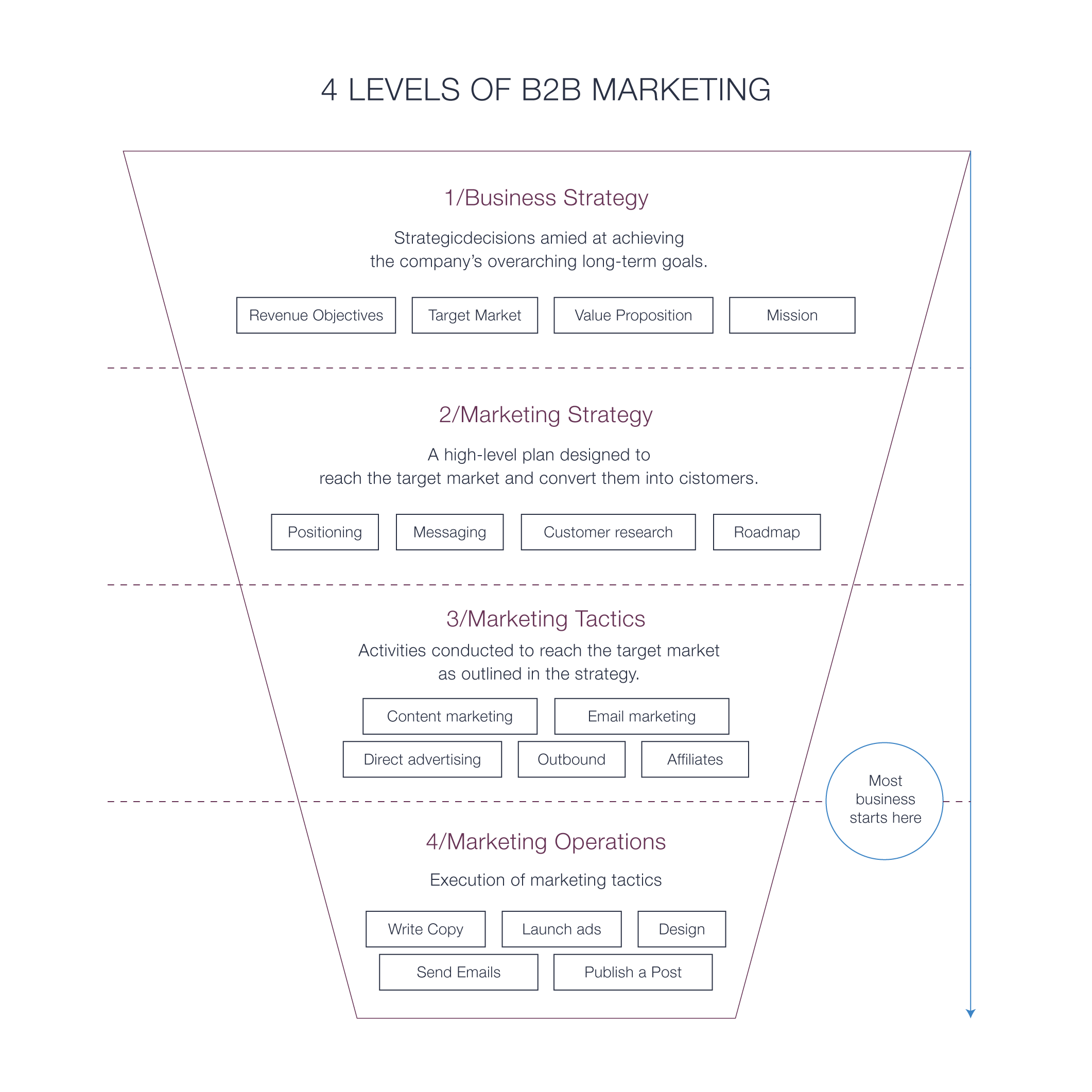
A Full-Service B2B Marketing Agency, Built for Revenue
A full service agency functions as a growth partner that connects your marketing directly to pipeline and revenue - explore our approach to inbound marketing to see how strategy translates into measurable outcomes. The term “full-service” means comprehensive coverage, from strategy and research through creative development, media, and analytics, rather than isolated tactics executed in silos.
Every activity aligns to specific business outcomes. Not vanity metrics like impressions or raw traffic, but measurable business outcomes:
- SQL volume and quality
- Opportunity creation rate
- Win rate improvement
- Average contract value growth
A strategic approach ensures that all marketing activities are aligned with client goals and positions clients as industry thought leaders, providing a well-planned framework for success.
This approach requires managing multiple channels in concert. A typical engagement covers B2B SEO, paid search, paid social, account-based marketing, email nurtures, marketing automation, and content creation, and conversion optimization, all working together.
The difference between a B2B-focused agency and a generalist is simple: specialists understand that a $250,000 enterprise deal with six decision makers requires fundamentally different tactics than a $50 consumer purchase.
For example, targeting US enterprise SaaS buyers means coordinating LinkedIn campaigns, industry publications, webinar series, and sales enablement assets around specific buying stages. That coordination is what separates strategic insight from scattered tactics.
A Better Way to Do B2B Marketing in 2026
Modern B2B marketing must address realities that generalist approaches ignore. Buying committees include procurement teams, executives, and end-users, each with different priorities. Complex sales cycles run 6–12 months. And buyers complete most of their research before your sales team ever gets a meeting.
The answer is an omnichannel approach that meets decision makers at multiple touchpoints:
- LinkedIn for targeted professional audiences
- Google Ads for high-intent search queries
- Trade media and industry newsletters for credibility
- Webinars and virtual events for education
- Retargeting flows to stay present throughout long cycles
Data and buyer intelligence drive prioritization. Instead of broad, unfocused campaigns, you identify high-value accounts and ideal customer profiles (ICPs) that match your best existing customers. This isn’t guesswork, it’s CRM analysis combined with intent data and competitive intelligence.
The real work is turning data into narratives that move prospects forward:
- Case studies demonstrating ROI for similar companies
- Comparison guides addressing common objections
- ROI calculators that quantify value in their terms
- Product explainers that answer technical questions
The goal is qualified demo requests and RFP invites, not just website traffic or form fills that never convert. 310 Creative's outbound lead generation service focuses exactly on this outcome , building structured outbound programs that generate qualified pipeline rather than vanity metrics. Content marketing and demand generation exist to generate leads that your sales team can actually close.
From Research to Results: How Strategy Becomes Pipeline
Effective B2B work starts with research. Not assumptions, not what worked at your last company, actual data about your market, customers, competitors, and internal performance.
Specific research inputs include:
- Win–loss interviews from 2022–2025 deals
- CRM analysis of closed-won and closed-lost patterns
- Competitive content audits and positioning analysis
- Keyword and intent data showing what buyers actually search
- Customer surveys identifying pain points and decision criteria
These insights become the foundation of a marketing strategy:
- Positioning platform: What you stand for and how you differ
- Messaging matrix: Key proof points mapped to each buyer persona
- Content roadmap: Topics and formats aligned to buying-stage questions
- Channel plan: Where to reach your ICP at each stage
Integrated campaigns get built from this strategy, content, paid media, email nurtures, and sales enablement assets all pulling in the same direction. The marketing plan isn’t a wish list; it’s a documented path from awareness to closed revenue.
Activating Your Next B2B Campaigns
Strategy without execution is just a slide deck. This is the “go-live” phase, turning plans into live campaigns across search, social media, email, and account-based channels.
Initial launch steps focus on controlled experimentation:
- Pilot campaigns testing 2–3 message variants
- A/B testing offers, headlines, and creative approaches
- Setting baseline benchmarks for CPL, MQL, and SQL
- Establishing lead scoring criteria with your sales team
A 2026 LinkedIn campaign for B2B cybersecurity buyers, for example, might test compliance-focused messaging against ROI-focused messaging to see which resonates with CISOs versus IT directors.
Ongoing optimization happens through weekly performance reviews:
- Reallocating budget to best-performing audiences
- Pausing underperforming ad campaigns
- Refining targeting based on early conversion data
- Adjusting bidding strategies as data accumulates
Common problems get solved in real-time:
|
Issue |
Solution |
|
Low-quality leads |
Tighten targeting, add qualification questions |
|
Long response times |
Automate initial nurture, alert sales faster |
|
Marketing-to-sales gaps |
Align MQL/SQL definitions, create handoff protocols |
|
High CPL with low close rate |
Shift budget to higher-intent channels |
PPC management, social media marketing, and digital advertising all require this continuous refinement. Campaign activation isn’t a one-time event, it’s an ongoing cycle of testing, learning, and improving conversion rates.
How a B2B Marketing Agency Works With Your Team
A strong agency behaves as a strategic partner, not a disconnected vendor. That means integrating with your marketing, sales, and RevOps functions as a true extension of your team.
Typical collaboration rhythms include:
- Weekly standups: Campaign performance, blockers, immediate optimizations
- Monthly performance reviews: Pipeline impact, KPI tracking, budget allocation
- Quarterly planning: Strategic adjustments tied to revenue targets
Transparency isn’t optional. Shared dashboards show real-time performance.
KPIs are documented and agreed upon upfront:
- Pipeline sourced and influenced
- Customer acquisition cost (CAC)
- LTV:CAC ratio
- SQL-to-opportunity conversion
- Opportunity-to-close rate
A collaborative approach with sales is essential for improved lead generation.
This means:
- Aligning definitions of MQL and SQL before campaigns launch
- Building sales enablement content that reps actually use
- Creating follow-up cadences for inbound and ABM leads
- Regular feedback loops on lead quality
Marketing agencies that operate in isolation from sales consistently underperform. Effective communication between teams is what turns marketing activity into real growth.

Core Services You Can Expect from a B2B Marketing Agency
B2B companies typically buy a connected set of marketing services rather than isolated tactics. Here’s a concise overview of the main categories that drive pipeline and revenue.
|
Service Category |
What It Includes |
Example |
|
Strategy & Positioning |
ICP definition, competitive analysis, messaging |
Positioning workshop for a fintech scaling to enterprise |
|
Brand & Messaging |
Visual identity, voice guidelines, narrative development |
Refreshing brand for 2026 market expansion |
|
Content Marketing |
Articles, whitepapers, case studies, webinars |
3-month webinar series for US mid-market manufacturers in Q4 2025 |
|
SEO |
Keyword strategy, technical optimization, link building |
Building organic traffic for high-intent product queries |
|
Paid Media |
Google Ads, LinkedIn, programmatic, retargeting |
Enterprise ABM campaign targeting Fortune 1000 |
|
Account-Based Marketing |
Named-account programs, personalized outreach |
Coordinated campaign for 50 strategic accounts |
|
Marketing Automation |
Email nurtures, lead scoring, workflow optimization |
HubSpot automation for multi-touch attribution |
|
Analytics & Reporting |
Dashboard creation, attribution modeling, testing |
Monthly pipeline attribution reporting |
Services are typically packaged into ongoing retainers or growth programs, not one-off projects. This allows for continuous optimization and compounding results over time.
Strategy, Research, and Positioning
Everything starts with understanding who you’re selling to and why they should choose you.
This subsection covers the foundational work:
- Surveying 2024–2025 customers to identify decision drivers
- Mapping buying committees and understanding each stakeholder’s concerns
- Identifying key proof points: ROI percentages, compliance certifications, performance benchmarks
- Competitive positioning to articulate your differentiation
Deliverables include messaging frameworks, narrative decks for sales enablement, and quarterly channel plans. This deep understanding of your market becomes the foundation every campaign builds upon.
Demand Generation and Lead Acquisition
Demand generation programs are designed to create qualified leads and opportunities, not just traffic. The focus is on high quality leads that convert through complex sales cycles.
Key tactics include:
- Google Ads targeting high-intent queries (“enterprise ERP implementation 2026”)
- LinkedIn sponsored content for C-level and VP-level roles
- Retargeting flows keeping your brand present during long consideration phases
- Content syndication to reach buyers on industry platforms
2026 norms include multi-touch attribution integrated with CRM and marketing automation platforms. You track cost per opportunity and opportunity-to-close rate, not just cost per lead.
This is how you generate demand that actually translates to revenue.
Account-Based Marketing (ABM) and Enterprise Growth
ABM programs target enterprise and strategic accounts with personalized, coordinated outreach, fundamentally different from broad lead gen.
Tactics include:
- Named-account lists based on firmographic and intent data
- Personalized landing pages for specific companies
- Targeted advertising services reaching specific organizations
- 1:1 sales enablement assets for individual opportunities
An example: targeting Fortune 1000 manufacturers in North America with coordinated ad campaigns, email sequences, and SDR outreach in 2026. Marketing and sales work from the same account list, sharing intelligence and coordinating touches.
ABM generates pipeline growth from the accounts that matter most to your business.
Content, SEO, and Thought Leadership
Content is the engine of B2B education and trust. Buyers research extensively before engaging sales, your content needs to answer their questions and establish brand authority.
Content strategy covers:
- Articles and blog posts optimized for search visibility
- Whitepapers and research reports demonstrating deep expertise
- Case studies proving results for similar companies
- Webinars and virtual events for engagement
- Product explainers addressing technical questions
SEO underpins organic traffic growth. Keyword strategy maps search intent to content topics. Technical SEO ensures your site is crawlable and fast. Together, they build sustained website traffic without ongoing ad spend.
An example: building a content hub around “B2B data security compliance 2024–2026” to attract and nurture prospects researching this topic. You become the thought leaders they turn to when they’re ready to buy.
Customer Experience and Conversion Rates in B2B Marketing
In B2B marketing, customer experience is more than a buzzword, it’s a strategic lever for driving conversion rates and accelerating revenue growth. As buying committees grow larger and sales cycles become more complex, delivering a seamless, personalized experience at every touchpoint is essential for effective lead generation and demand generation.
A robust marketing strategy that prioritizes customer experience ensures that every interaction, whether through content, digital advertising, or social media marketing, addresses the unique needs of multiple decision makers. By leveraging a thoughtful content strategy and a diverse suite of service offerings, B2B marketing agencies can craft tailored journeys that foster increased brand awareness, build trust, and nurture high quality leads through the pipeline.
Conversion optimization sits at the heart of this approach. Rather than relying on vanity metrics, leading agencies use data-driven insights to refine every stage of the buyer journey, ensuring that each marketing dollar is invested in tactics that deliver measurable business outcomes. This means developing a deep understanding of your target audience, mapping out the intricacies of complex sales cycles, and creating content that speaks directly to the concerns of various stakeholders.
A full service agency brings together web development, creative development, content creation, and account based marketing to deliver integrated campaigns that generate demand and support sustainable growth. By combining digital advertising and social media marketing with proven methodology, agencies can drive improved lead generation, boost conversion rates, and deliver real growth for clients across various industries.
Selecting the right agency is critical. Look for a strategic partner with deep expertise in B2B marketing, a track record of delivering measurable results, and the ability to drive organic traffic, increase search visibility, and execute targeted ad campaigns. The best agencies act as an extension of your team, using effective communication and a collaborative approach to align marketing services with your business needs and long-term goals.
In today’s competitive landscape, agencies that prioritize customer experience and conversion rates help businesses stay ahead, establish brand authority, and achieve sustainable pipeline growth. Whether through media planning, public relations, or innovative content creation, the key to success lies in creating meaningful, personalized experiences that resonate with your audience, driving conversion rates, generating high quality leads, and fueling long-term business growth.
Why Partnering With a B2B Marketing Agency Drives Growth
Specialized B2B agencies understand complex sales environments in ways generalist or B2C-focused shops simply don’t. They’ve built proven methodology for reaching multiple decision makers and navigating buying committees.
Key advantages include:
- Specialized expertise: Deep understanding of B2B buyer psychology and long sales cycles
- Faster ramp-up: Proven playbooks mean less trial and error
- Broader skill set: Access to strategists, creatives, media buyers, and analysts without hiring each role
- Objective perspective: Fresh eyes on positioning and messaging
Financial benefits are concrete:
- Avoiding the cost of building a full in-house team in 2026
- Improving CAC through optimized channel allocation
- Accelerating time-to-pipeline with experienced execution
- Accessing enterprise tools (analytics, automation) without individual licenses
Strategic value compounds over time. Agencies provide market benchmarking, competitive intelligence, and guidance on evolving AI capabilities, privacy regulations, and platform changes. They help you stay ahead of shifts that internal teams might miss.
The focus remains on revenue-linked outcomes. Power digital results, pipeline sourced, opportunities created, deals closed, not just activity metrics.
How to Choose the Right B2B Marketing Agency for Your Business
Fit matters more than flashy credentials. The right agency has experience in your industry, alignment with your growth stage, and cultural compatibility with how your team works.
Look for concrete proof:
- Case studies from 2022–2026 with measurable pipeline impact
- Verified client testimonials from companies similar to yours
- Clear examples of working with multiple stakeholders in complex deals
Evaluation criteria to prioritize:
- ICP understanding: Can they articulate who you’re targeting and why?
- Revenue fluency: Do they talk in pipeline terms or just marketing metrics?
- Transparent reporting: Will you see real data, not just polished decks?
- Strategic process: Is there a clear methodology or just ad hoc tactics?
Ask about tools and integration:
- Which CRM and marketing automation platforms do they work with?
- How will they integrate with your existing sales and RevOps workflows?
- What does web development support look like if needed?
Other agencies might offer lower prices or flashier promises. The right agency operates as an extension of your team, not just running ad campaigns, but driving toward your business needs and revenue goals.
The difference between a vendor and a strategic partner shows up in how they respond when something isn’t working. Partners diagnose and adapt; vendors make excuses.
Next Steps: Getting Started With a B2B Marketing Firm
Getting started follows a straightforward path:
- Initial consultation: Align on goals, challenges, and fit
- Audit of existing programs: Review current campaigns, data, and performance
- Strategy workshop: Define ICP, positioning, and channel priorities
- First 90-day plan: Balance quick wins with foundational setup
The first 90 days should focus on two tracks:
- Quick wins: Improving existing campaigns, fixing obvious gaps, generating early results
- Foundation: Setting up tracking, attribution, and reporting for long-term optimization
Come prepared with:
- CRM data from recent quarters
- Current KPIs and benchmarks
- Clear revenue goals for the next 12–18 months
- Access to key stakeholders (sales leadership, RevOps, executives)
Marketing strategists can accomplish more when they start with real data rather than assumptions.
The right B2B marketing company is a long-term partner in customer generation and real growth, not a short-term fix. Start with a conversation about your goals, evaluate fit carefully, and build a relationship designed to drive growth across various industries and market conditions.
Your next step is simple: bring your data, define your goals, and find a partner who measures success the same way you do, in pipeline and revenue.
Share this
Subscribe
Recent Posts
NEED TO INCREASE REVENUE?
Improve Your Marketing ROI
Let’s talk and see how we can help you scale a steady stream of new leads, customers and revenue.
